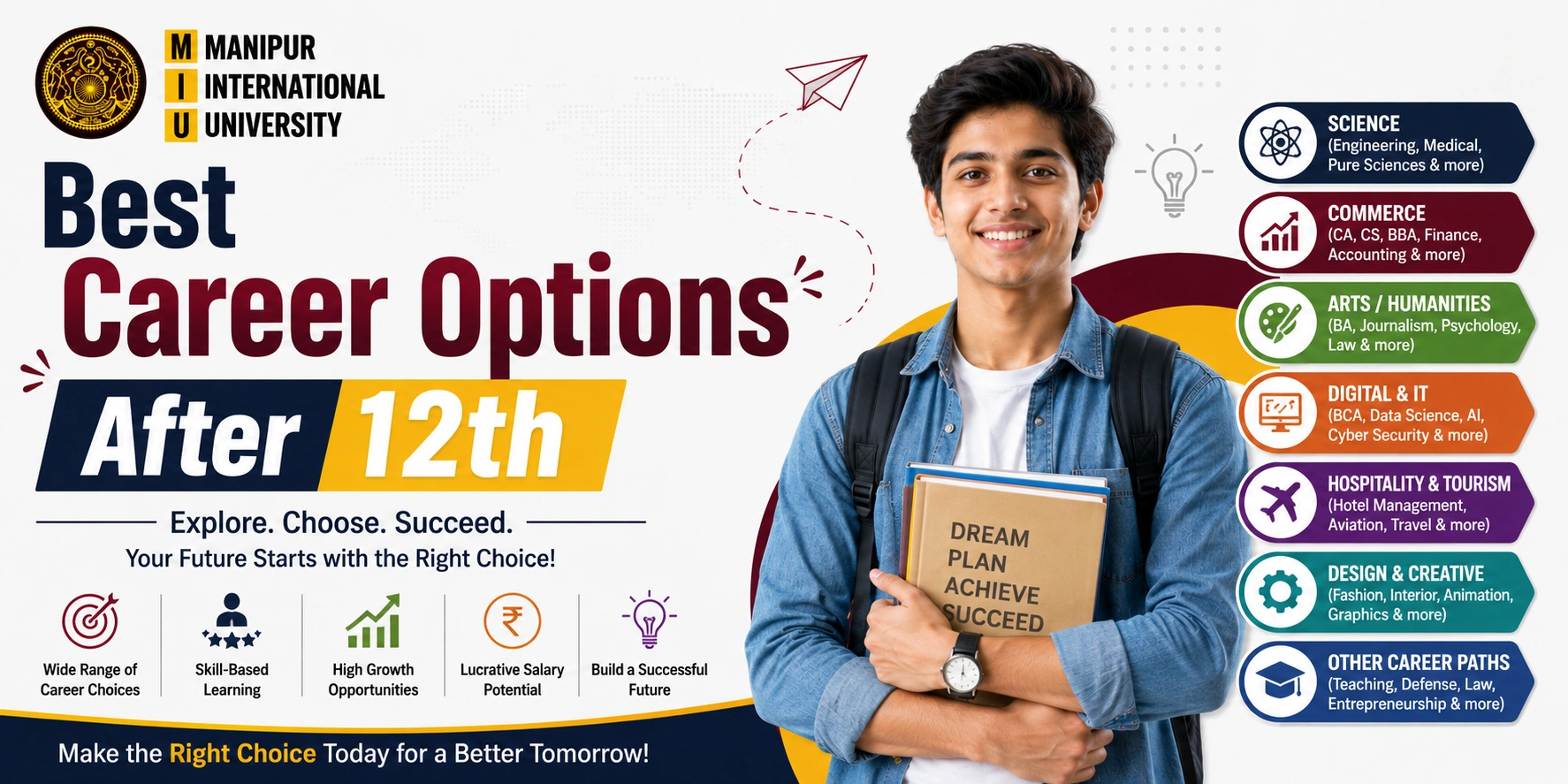
The best job oriented courses after 12th focus on practical skills, industry-relevant training, and clear career pathways. Students can explore B.Voc degrees, diploma programs, and short-term skill courses in areas such as IT, healthcare, digital marketing, tourism, banking, design, and business.
The right course depends on your Class 12 stream, interests, eligibility, career goals, and the level of practical training offered by the institution.
After Class 12, students often face an important question: What should I study to become job-ready? A traditional degree can be a good choice, but students who want career-focused learning may prefer a program that combines classroom education with practical training.
This guide explains what job-oriented courses are, options for Science, Commerce, and Arts students, short-term and 1-year programs, and how to choose a course that supports long-term career growth.
What Are Job Oriented Courses After 12th?
Job-oriented courses after 12th provide work-related training and skills useful for employment. MIU provides career-oriented B.Voc and other vocational programs in IT and Web Technology, Data Analytics, Healthcare and Allied Healthcare, Digital Marketing, Tourism and Hospitality, Beauty and Wellness, Design and Multimedia, and other such skill-based programs. These programs combine books and classroom learning with practical training and teach students relevant skills for the job and help students in establishing a firm base for their career.
Best Job Oriented Courses After 12th
Students from different streams can explore career-focused courses across technology,
|
Course/Field |
Suitable Stream |
Typical Duration* |
Key Skills |
Career Areas |
|
IT, Software Development & Web Technology |
Science, Commerce and eligible students from other streams |
Up to 3 years for B.Voc; shorter options may vary |
Programming, web development, databases, software tools |
IT companies, software firms, startups |
|
Healthcare & Paramedical Sciences |
Usually Science, depending on program |
Up to 3 years for B.Voc; varies by course |
Laboratory skills, patient support, medical equipment |
Hospitals, diagnostic centres, clinics |
|
Digital Marketing & E-commerce |
Any stream, subject to eligibility |
Short-term to 3 years |
SEO, content, social media, analytics |
Agencies, brands, e-commerce businesses |
|
Tourism & Hospitality |
Any stream, subject to eligibility |
Certificate to 3 years |
Guest service, travel operations, hospitality management |
Hotels, travel companies, tourism businesses |
|
Banking & Finance |
Commerce preferred for some programs |
Certificate to 3 years |
Banking operations, accounting basics, documentation |
Banks, NBFCs, financial services |
|
Retail & Business Management |
Any stream |
Certificate to 3 years |
Sales, customer service, inventory, operations |
Retail companies, e-commerce, business support |
|
Agriculture & Rural Development |
Eligibility varies by program |
Certificate to 3 years |
Agricultural practices, rural enterprise, sustainability |
Agri-businesses, rural development sector |
*Duration and eligibility may vary by course and institution. Check the official course page for current details.
*Duration and eligibility vary by course and institution. Always check the official course page for current details.
Best Job Oriented Courses After 12th Science
Post 12th grade, students of science can choose from several industry-focused courses. MIU offers students the opportunity to consider B.Voc., or other vocational courses in IT and Web Technology, Data Analytics, Healthcare and Allied Healthcare, along with several other skill based areas. These courses help in developing knowledge and skills needed to pursue several different careers.
For PCM Students
Students with Physics, Chemistry, and Mathematics can consider:
- IT and software development
- Web and internet technologies
- Data analytics and related technology fields
- Automotive and technical programs
- Renewable energy and technical fields
For PCB Students
Students with Physics, Chemistry, and Biology can explore healthcare and paramedical areas such as:
- Medical Laboratory Technology
- Medical Imaging Technology
- Physiotherapy
- Operation Theatre Technology
- Dialysis Technology
- Critical Care Technology
- Optometry
- Other healthcare-related vocational programs
For Computer Science Students
Students who studied Computer Science may consider:
- Software development
- Web technologies
- IT and IT-enabled services
- Programming-focused vocational programs
- Data and technology-related fields
Eligibility differs across programs. Before applying, check the required subjects, minimum marks, and other admission conditions for the specific course.
For a broader comparison of options, you can also explore our guide to best courses after 12th Science.
Best Job Oriented Courses After 12th Commerce
Students can pursue career-focused path ways in Digital Marketing, Data Analytics, IT and Web Technology, Retail, and Business, among other experiential and skills-based programs. These courses will equip students with relevant skills to prepare them for employment opportunities in the business, technology, and digital domains.
Commerce students are not limited to finance and business. Depending on eligibility, they can also explore fields such as digital marketing, multimedia, IT-enabled services, and other skill-based programs.
You can also read our detailed guide on career options after 12th Commerce for more ideas.
Best Job Oriented Courses After 12th Arts/Humanities
Arts and Humanities students can build careers in fields that value communication, creativity, customer interaction, and organizational skills.
Some options include:
- Tourism and Hospitality
- Digital Marketing
- Multimedia and Animation
- Fashion Design
- Interior Design
- Event Management
- Theatre and Fine Arts
- Beauty and Wellness
These fields can be suitable for students who enjoy creative work, communication, service, or people-focused roles.
The important point is to choose a course based on your interests, eligibility, practical training, and career goals rather than selecting a program only because it is popular.
For additional ideas, see our guide to best courses after 12th Arts.
Short-Term Job Oriented Courses After 12th
Short-term courses can help students develop a specific skill within a relatively short period. Depending on the field, these programs may last from a few weeks to several months.
They can be useful if you:
- Want to learn a specific skill quickly
- Want to explore an industry before choosing a longer program
- Want to add a practical skill alongside another degree
- Need training in a particular software or professional tool
- Want to improve your employability with additional skills
Examples may include introductory programs in digital marketing, computer applications, design tools, customer service, or other industry-specific skills.
However, short-term learning is not suitable for every career. Fields such as healthcare may require structured education, practical training, and specific eligibility requirements.
6 Months Job Oriented Courses After 12th
Six-month job-oriented courses can offer more structured training than very short certificate programs while taking less time than a full diploma or degree.
Depending on the institution and specialization, students may find programs related to:
- Digital marketing
- Computer and IT skills
- Retail and customer service
- Design and multimedia
- Business support
- Industry-specific technical skills
Before choosing a six-month program, check:
- Course syllabus
- Practical training
- Projects
- Certification
- Faculty or trainer experience
- Industry relevance
- Career support
- Total course cost
Do not judge a course only by its duration. What you learn and how you practice those skills matters more.
1 Year Job Oriented Courses After 12th
Vocational training may be a good option for students who have recently completed their 12th year at school and who want a course that is one year in duration that leads to an employment opportunity. Popular short courses are available for web technology, data analytics, digital marketing, design and other retail, business and IT related activities. This kind of training is likely to equip you with relevant career skills in under a year. Short courses are available from many different services and so steps to skill acquisition may vary.
Before enrolling, check:
- Whether it is a standalone diploma or part of a longer degree pathway
- Practical and laboratory components
- Internship opportunities
- Exit and progression options
- Eligibility requirements
- Total fees
- Career support
A one-year program can be useful for students who want focused training while keeping the option of further education open.
Government Job Oriented Courses After 12th
A vocational course can help students build relevant skills for certain government-sector roles, but no course can guarantee a government job.
Government recruitment usually has its own eligibility conditions, examinations, selection processes, and recruitment rules.
Depending on the qualification and recruitment requirements, students may explore fields such as:
- Healthcare and paramedical services
- IT and computer-related roles
- Agriculture and rural development
- Technical and support services
If your goal is a government job, treat a vocational course as a way to build relevant knowledge and skills. Always check the latest eligibility requirements and recruitment notifications issued by the relevant government organization.
Job Oriented Courses After 12th for Girls
Job-oriented courses are not restricted by gender. Students can choose IT, healthcare, digital marketing, finance, tourism, design, agriculture, management, and other fields based on their eligibility and interests.
When choosing a course, focus on:
- Your interests and strengths
- Course eligibility
- Practical training
- Career opportunities
- Internship options
- Institute credibility
- Long-term growth
The most suitable course is the one that matches your skills and career goals rather than one selected because it is considered suitable for a particular gender.
How to Choose the Best Job Oriented Course After 12th
Choosing a career-focused course should involve more than looking at the course name. Consider these factors before applying:
- Check your stream – Make sure your Class 12 subjects meet the course requirements.
- Understand your interests – Choose a field you can realistically see yourself working in.
- Check eligibility – Review minimum marks, subjects, and admission requirements.
- Compare course duration – Decide whether you need short-term training, a diploma, or a degree.
- Look for practical training – Check for labs, projects, workshops, simulations, or hands-on learning.
- Check industry exposure – Look for live projects, expert sessions, industry visits, or practical assignments.
- Review internship opportunities – Practical workplace experience can strengthen your skills.
- Understand placement support – Check what type of career guidance or placement assistance is provided.
- Research career roles – Identify realistic entry-level jobs associated with the qualification.
- Compare total costs – Consider tuition, additional expenses, and the full duration of the program.
Taking time to compare these factors can help you choose based on actual career value rather than marketing claims.
Vocational Courses vs Traditional Degree Courses
Both vocational and traditional degree programs can support successful careers. The main difference is the learning approach and career focus.
|
Factor |
Vocational/Job-Oriented Courses |
Traditional Degree Courses |
|
Learning style |
Practical and applied |
Often broader and more academic |
|
Industry orientation |
Usually focused on specific skills or occupations |
Depends on the course and institution |
|
Practical learning |
Often includes hands-on training |
Varies by program |
|
Internships |
May be included depending on the program |
Depends on the institution and course |
|
Skill development |
Applied and occupation-focused |
Broader conceptual and analytical learning |
|
Higher-study options |
Depend on qualification and institution rules |
Usually established within the academic system |
|
Job readiness |
Can support faster preparation for defined roles |
May require additional practical upskilling for some careers |
Neither path is automatically better.
A student who wants practical, career-focused learning may prefer a vocational program. Someone planning to enter research, academia, or a profession requiring a specific academic qualification may prefer a traditional degree.
The right choice depends on your long-term career goal.
Why B.Voc Can Be a Job-Oriented Option After 12th
B.Voc (Bachelor of Vocation) is a degree-level program that combines academic education with vocational and practical skill development.
It can be a useful option for students who want an undergraduate qualification while developing industry-focused skills.
At Vocational MIU, students can explore B.Voc programs across areas such as:
- IT, ITES and Software Development
- Paramedical and Healthcare
- Tourism and Hospitality
- Banking and Finance
- Digital Marketing and E-commerce
- Agriculture and Rural Development
- Management and Entrepreneurship
- Other vocational disciplines
B.Voc programs generally take three years, although the exact structure, eligibility, curriculum, and progression options can vary by program.
Some vocational degree pathways may also provide structured exit qualifications during earlier stages of study. Students should check the individual program details before making an admission decision.
If you are comparing B.Voc with a short-term course, remember that a degree program requires a longer commitment but can provide broader academic and vocational preparation.
You can also read our detailed guide on What is a B.Voc Degree? to understand the qualification, structure, and career relevance in more detail.
Skills Employers Look For in Fresh Graduates
Technical knowledge is important, but employers may also value transferable skills that help graduates perform effectively in the workplace.
Important skills include:
- Communication – speaking and writing clearly in professional situations
- Digital literacy – using common software and online tools confidently
- Problem-solving – identifying problems and working toward practical solutions
- Basic data skills – understanding and interpreting information
- Industry tools – familiarity with software, equipment, or platforms used in your field
- Teamwork – collaborating effectively with colleagues
- Adaptability – learning new tools and processes as industries change
- Basic AI awareness – understanding how AI tools may be used in your chosen field
A strong job-oriented course should ideally develop both technical and transferable skills.
Career Opportunities After Job Oriented Courses
Career opportunities depend on your course, skills, qualification, practical experience, and the requirements of individual employers.
Depending on the specialization, students may explore opportunities in:
- IT companies and software firms
- Hospitals and diagnostic centres
- Marketing agencies and in-house marketing teams
- Hotels and tourism businesses
- Banks and financial services
- Retail and e-commerce companies
- Agriculture and agri-business organizations
- Design, media, and creative industries
A course should not be treated as a guarantee of a specific job or salary.
Career outcomes can vary based on skills, experience, location, employer requirements, and market conditions. Students should research actual entry-level roles and employer expectations before choosing a field.
Common Mistakes Students Should Avoid
1. Choosing a course only because of salary claims
A high salary does not mean a course is suitable for everyone. Consider your skills, interests, and career goals.
2. Following friends
Your strengths and career plans may be different from your friends' plans.
3. Ignoring eligibility
Always check subjects, marks, and other admission conditions before applying.
4. Skipping practical training
A course with little practical exposure may not provide the hands-on experience you expect.
5. Trusting unrealistic placement or salary promises
Claims about guaranteed jobs or fixed high salaries should be treated carefully. Ask for clear information about placement support and career outcomes.
6. Not researching career scope
Understand what entry-level roles are available and what skills employers expect.
7. Ignoring internships
Internships and practical projects can help you apply classroom learning and gain experience.
The best approach is simple: research the course, verify important claims, and compare multiple options before enrolling.
Final Takeaway
There is no single best job oriented course after 12th for every student.
Science students may explore technology, IT, healthcare, and technical fields. Commerce students can consider banking, finance, digital marketing, retail, and business-focused programs. Arts students may explore tourism, design, multimedia, communication, and other creative or service-oriented fields.
However, these categories are not fixed. Your eligibility, interests, skills, and career goals should guide your decision.
Whether you choose a short-term course, a six-month program, a one-year diploma, or a three-year B.Voc degree, focus on the quality of learning rather than the course name alone.
Before enrolling, check the curriculum, eligibility, practical training, internships, career support, total fees, and realistic career opportunities.
A genuinely job-oriented program should help you develop useful skills, understand your chosen industry, and become better prepared for the workplace.
Frequently Asked Questions
What are the best job oriented courses after 12th?
Popular options include IT and software development, healthcare and paramedical sciences, digital marketing, tourism and hospitality, banking and finance, retail, and B.Voc programs. The right choice depends on your stream, eligibility, interests, and career goals.
Which course is best for getting a job after 12th?
There is no single best course for everyone. Look for a program that provides relevant practical training, industry exposure, and skills aligned with your target career.
What are the best job oriented courses after 12th Science?
Science students can explore IT, software development, data-related fields, and healthcare or paramedical programs such as Medical Laboratory Technology, Medical Imaging Technology, Physiotherapy, Optometry, and other eligible programs.
What are the best job oriented courses after 12th Commerce?
Commerce students can consider banking and finance, digital marketing, e-commerce, retail management, business management, accounting-related programs, and entrepreneurship.
What are the best job oriented courses after 12th Arts?
Arts students can explore tourism and hospitality, digital marketing, multimedia and animation, fashion, interior design, event management, theatre, and other creative or service-oriented fields.
Are short-term courses after 12th good for jobs?
Short-term courses can help students develop specific skills quickly. However, some technical or regulated careers require longer education and structured practical training. Check the course requirements before enrolling.
What are 1-year job oriented courses after 12th?
One-year job-oriented programs are often diploma-level courses that provide more structured training than short certificates. The exact qualification and progression options depend on the institution and program.
Can a vocational course help me get a job?
A vocational course can help you develop relevant skills and improve job readiness, but no course can guarantee employment. Career outcomes depend on skills, performance, qualification, employer requirements, and market conditions.
Are vocational courses better than traditional degrees?
Neither is universally better. Vocational programs generally emphasize practical and occupation-focused skills, while traditional degrees may provide broader academic learning. Your career goal should guide the decision.
What should I check before choosing a job oriented course?
Check eligibility, curriculum, practical training, internship opportunities, course duration, total fees, career scope, career support, and the credibility of the institution.
Do job oriented courses guarantee a government job?
No. Government jobs usually have separate eligibility requirements, examinations, recruitment processes, and selection procedures. Always verify requirements with the relevant recruiting authority.
Are job oriented courses suitable for girls?
Yes. Students can choose any eligible field based on their interests, skills, and career goals. IT, healthcare, finance, tourism, design, management, and other career areas are open to students who meet the relevant requirements.