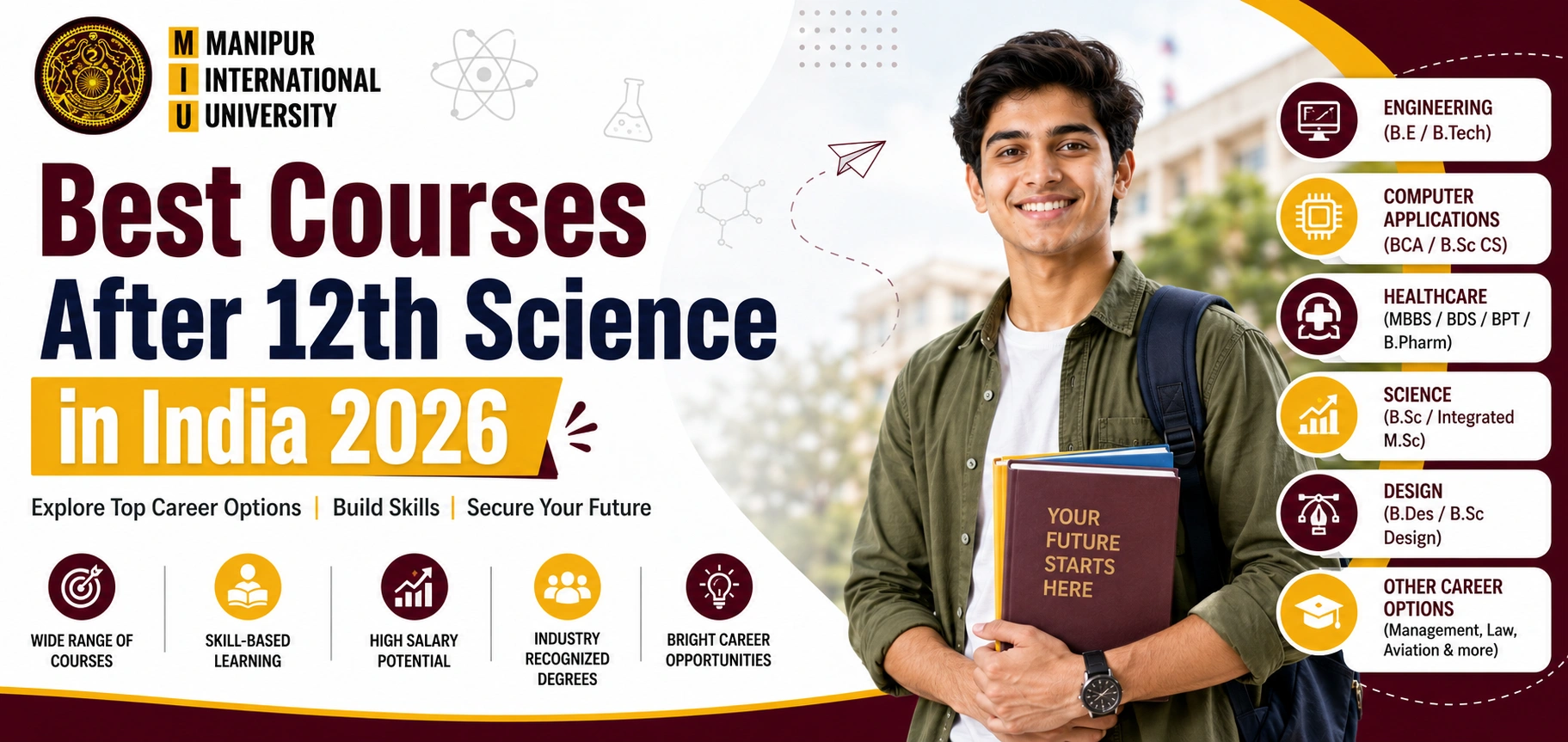
The best post 12th classes in India cover fields with rapid growth. These include technology, healthcare, data, applied sciences, and vocational streams. Courses under these streams include B.Tech, MBBS, BDS, BCA, B.Sc. Data Science, B.Pharm, and others. APCT, Data Analytics, Machine Learning & AI, Medical Laboratory Technology, Medical Imaging Technology, Critical Care Technology, Optometry, Dialysis Technology, and Agriculture & Rural Development, are a few of the rallying choices. The most appropriate selection relies on your PCM, PCB, or PCMB stream, most important requirements, and aspirations.e.
Best Courses After 12th Science in 2026
Here is a quick comparison of important courses to pursue after 12th Science. Prioritise the ones that match your stream and interest. Eligibility and admission steps vary by programme and institution, so always check the latest admission notification.
|
Course |
Suitable Stream |
Duration |
Admission/Eligibility |
Main Learning Area |
Career Area |
|
Applied Computer Technology |
PCM / PCMB |
Varies (UG/Diploma) |
Varies by institution |
Practical computing, software basics |
IT, software support |
|
Data Analytics |
PCM / PCMB |
Varies |
Varies by institution |
Data handling, reporting |
Analytics, business intelligence |
|
Machine Learning & AI |
PCM / PCMB |
Varies |
Varies by institution |
AI models, data science |
AI, automation |
|
Robotics & Artificial Intelligence |
PCM / PCMB |
Varies |
Varies by institution |
Automation, control systems |
Robotics, R&D support |
|
IoT Programming & Big Data |
PCM / PCMB |
Varies |
Varies by institution |
Connected devices, data |
IoT, data engineering |
|
IT/ITeS/Web Technology |
PCM / PCMB |
Varies |
Varies by institution |
Web development, IT services |
Web, IT support |
|
B.Tech (Engineering) |
PCM / PCMB |
4 years |
JEE / entrance based |
Core engineering |
Engineering roles |
|
Medical Laboratory Technology |
PCB / PCMB |
Varies |
Varies by institution |
Lab testing, diagnostics |
Diagnostic labs |
|
Medical Imaging Technology |
PCB / PCMB |
Varies |
Varies by institution |
X-ray, MRI, CT imaging |
Radiology support |
|
Optometry |
PCB / PCMB |
Varies |
Varies by institution |
Eye care, vision testing |
Eye clinics, optical care |
|
Operation Theatre Technology |
PCB / PCMB |
Varies |
Varies by institution |
Surgical assistance |
Hospitals, OT support |
|
Dialysis Technology |
PCB / PCMB |
Varies |
Varies by institution |
Dialysis procedures |
Nephrology units |
|
Critical Care Technology |
PCB / PCMB |
Varies |
Varies by institution |
ICU support |
Critical care units |
|
Agriculture & Rural Development |
PCB / PCM / PCMB |
Varies |
Varies by institution |
Crop science, rural systems |
Agri-services |
|
Green House Technology |
PCB / PCMB |
Varies |
Varies by institution |
Protected cultivation |
Agri-tech, horticulture |
Use this table as a starting point. The sections below explain each pathway in more detail for your stream.
Best Courses After 12th Science for PCM Students
After 12th Science, traditional career options for PCM students include engineering in computer science or artificial intelligence (B.Tech), numerous B.Sc programs in Data Science, and BCA programs. For those seeking practical and hands-on skills, students may consider Applied Computer Technology, Data Analytics, Machine Learning & Artificial Intelligence, Robotics & Artificial Intelligence, and Internet of Things (IoT) Programming along with Big Data. There are also other options like B. Arch and Commercial Pilot Training, which are for students who have the required qualifications.
If you like computers and want practical, applied learning rather than only theory, several skill-focused options are worth comparing:
- Applied Computer Technology — hands-on computing, software basics, and IT skills. Students who want practical computer education can explore Applied Computer Technology.
- Data Analytics — working with data, reports, and dashboards. A good fit if you like numbers and patterns.
- Machine Learning & AI — building models that learn from data. Suited to students curious about artificial intelligence.
- Robotics & Artificial Intelligence — automation, sensors, and control systems.
- IoT Programming & Big Data — connected devices and large-scale data handling.
- IT/ITeS/Internet & Web Technology — web development and IT services.
Traditional degree courses after 12th PCM are still strong choices. B.Tech remains the most common engineering route, usually through JEE or state entrance exams. BCA and B.Sc Computer Science suit students who want software and application skills. B.Sc Mathematics and B.Sc Physics work for those planning research or teaching. B.Arch is an option if you are interested in design and construction, and it usually needs a separate entrance test.
Here is a simple way to decide. If you want a longer academic route with core engineering depth, B.Tech may fit. If you prefer job-oriented, practical technical courses with earlier industry exposure, vocational and applied technology programmes are worth a close look.
Best Courses After 12th Science for PCB Students
The best courses after 12th Science for PCB students fall into two groups: NEET-based medical programmes and allied healthcare or paramedical programmes. If MBBS is not your only plan, several healthcare technology courses let you work in hospitals and diagnostics without following the doctor route.
Relevant healthcare and paramedical programmes to compare include:
- Medical Laboratory Technology — running diagnostic tests and lab samples.
- Medical Imaging Technology — X-ray, CT, MRI, and other imaging work.
- Critical Care Technology — supporting patients in ICUs.
- Optometry — vision testing and eye care.
- Dialysis Technology — handling dialysis procedures for kidney patients.
- Operation Theatre Technology — assisting surgical teams in the OT.
- Dental Hygiene — oral health and dental support.
- Physiotherapy — movement, recovery, and rehabilitation support.
Students interested in diagnostics can consider the Medical Laboratory Technology Program, while those interested in hospital procedures can consider either the Operation Theatre Technology or Dialysis Technology Program.
As a related example, PCB students also consider other traditional degrees such as MBBS and BDS (both NEET-based), B.Pharm, Nursing, Biotechnology, and Microbiology. These degrees have varying lengths, costs, and entrance requirements.
Here’s the thing: admission prerequisites vary by the program, college, state, and current regulations. Some healthcare programs need NEET; others follow admission at the institutional or state level. Always check the requirements before you apply.
Best Courses After 12th Science for PCMB Students
PCMB students have the widest choice because they studied both Mathematics and Biology. You can compare technology, healthcare, pure science, agriculture, and vocational pathways side by side.
In practice, this means you can move toward:
- Technology and computing — Applied Computer Technology, Data Analytics, or AI programmes.
- Healthcare — Medical Laboratory Technology, Optometry, or other allied-health courses.
- Agriculture and applied science — Agriculture & Rural Development or Green House Technology.
- Pure science degrees — B.Sc programmes in your chosen subject.
Your best move is to shortlist by interest first, then check eligibility. The extra subject flexibility helps, but it does not remove the need to pick one clear direction.
Best Courses After 12th Science Without NEET
The best courses after 12th Science without NEET include technology, computer applications, data analytics, AI, agriculture, pure sciences, vocational programmes, and several allied healthcare courses. If you do not plan to sit NEET, you still have many practical, job-oriented options across both PCM and PCB.
Common non-NEET directions include:
- Information technology and computing — software, web, and IT services.
- Data and AI — Data Analytics, Machine Learning & AI, IoT & Big Data.
- Agriculture — Agriculture & Rural Development, Green House Technology, Organic Agriculture.
- Pure science — B.Sc degrees in Physics, Chemistry, Maths, or Biology.
- Selected allied healthcare programmes — some laboratory and technology courses.
One common assumption to be careful with is that some healthcare or paramedical courses may not be NEET-free. Admission requirements for each course, institutional, and current regulations may vary. Before finalizing any decisions, check the admission notifications for the biology courses that are NEET-free.
High Salary Courses After 12th Science
High salary courses after 12th Science are usually found in data analytics, artificial intelligence, machine learning, computer technology, software and IT, engineering, medicine, and specialised healthcare. These fields tend to reward strong technical skills and practical experience, which can support better earning potential over time.
That said, no course guarantees a fixed salary. Your earning potential depends on several factors:
- Skills you actually build during the course.
- Practical experience through internships and projects.
- Specialisation and how in-demand it is.
- Employer, industry, and location.
- Institution and the quality of training.
For PCM students, high-earning directions often sit in AI, data, and software roles. For PCB students, specialised healthcare and diagnostic roles can grow well with experience. Treat any salary figure you see online as indicative, not a promise. Focus on building skills that employers need, because that is what drives income over the long run.
Job-Oriented Courses After 12th Science
A job-oriented course after 12th Science is one that builds practical, work-ready skills alongside theory. Instead of only reading concepts, you apply them. That is what makes these courses useful for employability.
Job-oriented and skill-based courses usually include:
- Practical training and hands-on lab work.
- Internships with real workplaces.
- Projects that mirror actual tasks.
- Industry exposure through guest sessions or site visits.
- Technical skills relevant to a specific field.
- Digital skills such as tools and software.
- Communication and problem-solving practice.
Many vocational programmes are built around these elements. For example, applied technology courses focus on software and data work you can show in a portfolio. Healthcare technology courses include clinical and lab practice. Agriculture programmes include field and greenhouse work. This practical structure is what separates career-oriented courses from purely theoretical ones.
Vocational Courses After 12th Science
Vocational courses after 12th Science are skill-based programmes that combine classroom learning with hands-on training. The goal is simple: help you build the practical abilities a specific job needs. These courses focus on real tasks, industry tools, and workplace exposure rather than theory alone.
Vocational education can suit students who want to enter the workforce with usable skills, or who prefer applied learning over long theoretical study. Many programmes include internships, lab practice, and project work.
Relevant MIU vocational programmes fall into three main categories.
Technology
- Applied Computer Technology
- Data Analytics
- IT/ITeS/Internet & Web Technology
- Machine Learning & AI
- Robotics & Artificial Intelligence
- IoT Programming & Big Data
Students who enjoy computers and want an applied route can compare these programmes based on the skills each one builds.
Healthcare
- Medical Laboratory Technology
- Medical Imaging Technology
- Critical Care Technology
- Optometry
- Dialysis Technology
- Operation Theatre Technology
These suit students interested in hospitals, diagnostics, and patient support roles that do not always require the MBBS route.
Agriculture
- Agriculture & Rural Development
- Green House Technology
- Organic Agriculture
These fit students who want to work in farming systems, agri-technology, and rural development.
One common vocational degree pathway is the B.Voc (Bachelor of Vocation). It is an undergraduate skill-based degree that mixes practical training with academic learning. If you want to understand this route, you can read what is a B.Voc degree and review the B.Voc course details before you apply. Keep it as one option among several, not the only one.
Degree, Diploma and Professional Courses After 12th Science
Course type matters as much as course subject. A degree, diploma, professional course, and vocational degree each suit different goals. Here is a short comparison.
|
Course Type |
Typical Duration |
Focus |
Who It May Suit |
|
Degree (B.Sc, B.Tech) |
3–4 years |
Academic depth |
Students planning higher study or research |
|
Diploma |
1–3 years |
Focused practical skills |
Students wanting a shorter, quicker route |
|
Professional Course |
Varies |
Specialised field skills |
Students targeting a specific profession |
|
Vocational Degree (B.Voc) |
3 years |
Skill + academic mix |
Students wanting job-ready practical training |
Choose based on time, cost, and how quickly you want work-ready skills. A degree offers depth. A diploma is shorter and focused. A vocational degree tries to balance both. There is no single best type; it depends on your plan.
How to Choose the Best Course After 12th Science
Picking the right course is easier when you work through it step by step. Use this practical framework to narrow your options.
- Confirm your stream — PCM, PCB, or PCMB decides which courses you are eligible for.
- Check your interest — pick a field you can study for three or four years without losing motivation.
- Choose a broad field — technology, healthcare, agriculture, or pure science.
- Verify eligibility — confirm subject and marks requirements for each shortlisted programme.
- Check entrance requirements — some courses need JEE, NEET, or CUET; others use institution-level admission.
- Compare course duration — decide whether you want a shorter diploma or a full degree.
- Review fees — plan for total cost, not just first-year fees.
- Look at practical exposure — check for internships, labs, and projects.
- Assess industry demand — favour skills that employers are actively hiring for.
- Consider higher-study options — check whether the course allows further study later.
- Check institution quality — review faculty, labs, and training facilities.
- Factor in location — consider travel, hostel, and living costs.
Work through these points for each shortlisted course. The programme that scores well across most of them is usually your strongest choice.
Career Scope After Different Science Courses
Different courses lead to different work areas. This table maps common Science courses to possible career areas. It shows direction, not a promise of any specific job, since employability depends on your skills, experience, and the market.
|
Course/Field |
Possible Career Areas |
|
Applied Computer Technology |
IT support, software assistance, web roles |
|
Data Analytics |
Data analysis, reporting, business intelligence |
|
Machine Learning & AI |
AI support roles, data science, automation |
|
Robotics & AI |
Robotics support, automation, R&D assistance |
|
IoT & Big Data |
IoT roles, data handling, connected systems |
|
Medical Laboratory Technology |
Diagnostic labs, pathology support |
|
Medical Imaging Technology |
Radiology and imaging departments |
|
Optometry |
Eye clinics, optical retail, vision care |
|
Operation Theatre Technology |
Hospital OT teams, surgical support |
|
Agriculture & Rural Development |
Agri-services, rural development roles |
|
Green House Technology |
Horticulture, protected farming, agri-tech |
Use this as a guide to see where each course can lead. Your actual path depends on the effort and skills you build during the programme.
If you are still weighing broader directions before choosing a course, you can also review the best career options after 12th for wider context.