Digital Marketing Meaning: Definition, Channels, Object...
Digital marketing is one of the important methods of marketing that companies us...

The Manipur International University (MIU) is an Autonomous Statutory International University established, recognized, and institutionally accredited by the State Government of Manipur.
Faculty Members
Year Established
Academic Programs
Research Centers
Discover your perfect program from our industry-aligned courses


Bachelor of Vocation (B.Voc.) as defined under the University Grants Commission (UGC) guidelines is a skill-based undergraduate degree program that integrates vocational training with academic education. It was introduced by UGC to improve employability, provide job-ready skills, and bring flexibility in higher education.
The UGC has specified B.Voc. as a formal undergraduate degree under the UGC Act, 1956, and it is recognized at par with other bachelor's degrees (like BA, BSc) for purposes such as competitive examination and further education.
Designed to offer a balanced mix of practical skills and general education so that students become work-ready while also retaining the option to pursue higher studies.
Unlike traditional degrees which are theory-centric, B.Voc. ensures hands-on vocational training in industry-relevant areas, making graduates job-ready.
Real experiences from our graduates and current students
"The PG Diploma program at MIU is flexible and career-oriented. It is perfect for students and working professionals looking to upgrade their skills. The curriculum is relevant and ..."

"The BCA course at Manipur International University is well-structured and aligned with current IT industry trends. The emphasis on practical training, coding skills, and project wo..."
"I chose MIU for my M.Sc program because of its focus on research and innovation. The university provides excellent academic support, and the faculty encourages students to particip..."
"The MBA program at Manipur International University is highly industry-oriented. From internships to live projects and guest lectures, everything is designed to provide real-world ..."
"The BSC program at MIU has helped me grow academically and personally. The university promotes holistic development through cultural activities, seminars, and skill-based learning,..."
"Choosing Manipur International University for my BBA was one of the best decisions. The university offers a career-focused undergraduate program with practical exposure, case studi..."
A comprehensive framework designed for skill development and academic excellence
3-year undergraduate program (6 semesters) with flexible learning options
Perfect blend of practical training and academic knowledge
Flexible learning pathways with recognized certifications
National Skills Qualification Framework compliant

Digital marketing is one of the important methods of marketing that companies us...
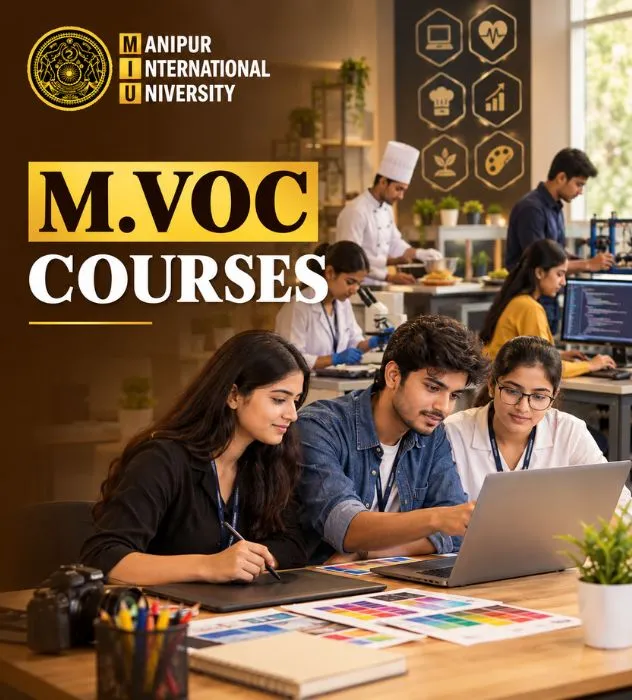
M.Voc means masters of vocational, it is a postgraduate level program offered fo...

Ganesh Chaturthi will occur on Monday, September 14, 2026. This festival is dedi...

Find answers to common questions
MIU provides skill-based and vocational programmes that combine academic learning with practical training. Students can explore different career-focused fields and choose programmes designed around skill development and industry-relevant learning.
Yes, vocational courses can help students build career-focused skills for specific industries. Practical training, subject knowledge and hands-on experience can help students prepare for employment, further education or self-employment.
The best vocational course after 12th depends on your interests, subjects, skills and career goals. Popular areas include technology, healthcare, design, agriculture, hospitality and other skill-based fields. Choose a course that matches the type of work you want to do in the future.
You can apply by selecting your preferred vocational programme and following the admission process provided by MIU. First, check the course eligibility and requirements, then complete the application form and submit the required details and documents.
Eligibility depends on the course you choose. Many undergraduate vocational programmes require students to have passed Class 12 from a recognised board, while some courses may have additional subject or qualification requirements.
Yes, MIU vocational programmes focus on practical training along with academic education. Depending on the programme, students may learn through practical sessions, projects, labs, workshops or other hands-on activities.
Yes, students can pursue higher studies after completing a B.Voc degree, subject to the eligibility rules of the university and programme they choose. A B.Voc degree can also allow students to gain work experience before continuing their education.
A B.Voc programme is generally a 3-year undergraduate programme divided into 6 semesters. The programme combines skill training with general education and provides a structured path toward a B.Voc degree.
Vocational and traditional degree courses serve different learning needs. Vocational courses usually focus more on practical and job-related skills, while traditional degrees may place greater focus on academic and theoretical learning. The better choice depends on your career goal and preferred way of learning.
Yes, MIU vocational programmes focus on skill development along with academic learning. Students get opportunities to build practical knowledge and apply what they learn to real-world tasks.
A vocational course can be a good choice if you want to learn practical skills along with academic knowledge. These programmes focus on industry-related learning and can help students prepare for careers in areas such as IT, healthcare, design, hospitality and other growing fields.
B.Voc stands for Bachelor of Vocation. It is a skill-based undergraduate degree that combines academic education with practical vocational training. The programme is designed to help students develop useful skills while earning a recognised bachelor's degree.
Yes, students who have completed Class 12 can apply for many undergraduate vocational courses at MIU. The exact eligibility depends on the course, so students should check the requirements of their chosen programme before applying.
MIU offers skill-based and vocational programmes in different career areas, including technology, healthcare, agriculture, design, hospitality and other practical fields. Students can explore the available courses and choose a programme based on their interests and career goals.
Vocational courses are skill-based programmes that teach practical skills for a specific career or industry. They combine academic learning with hands-on training in fields such as technology, healthcare, design, agriculture and hospitality.
MIU is duly approved and listed by the University Grants Commission (UGC), Ministry of Education, Government of India under section 2(f) of UGC Act, 1956 as a State Private University.