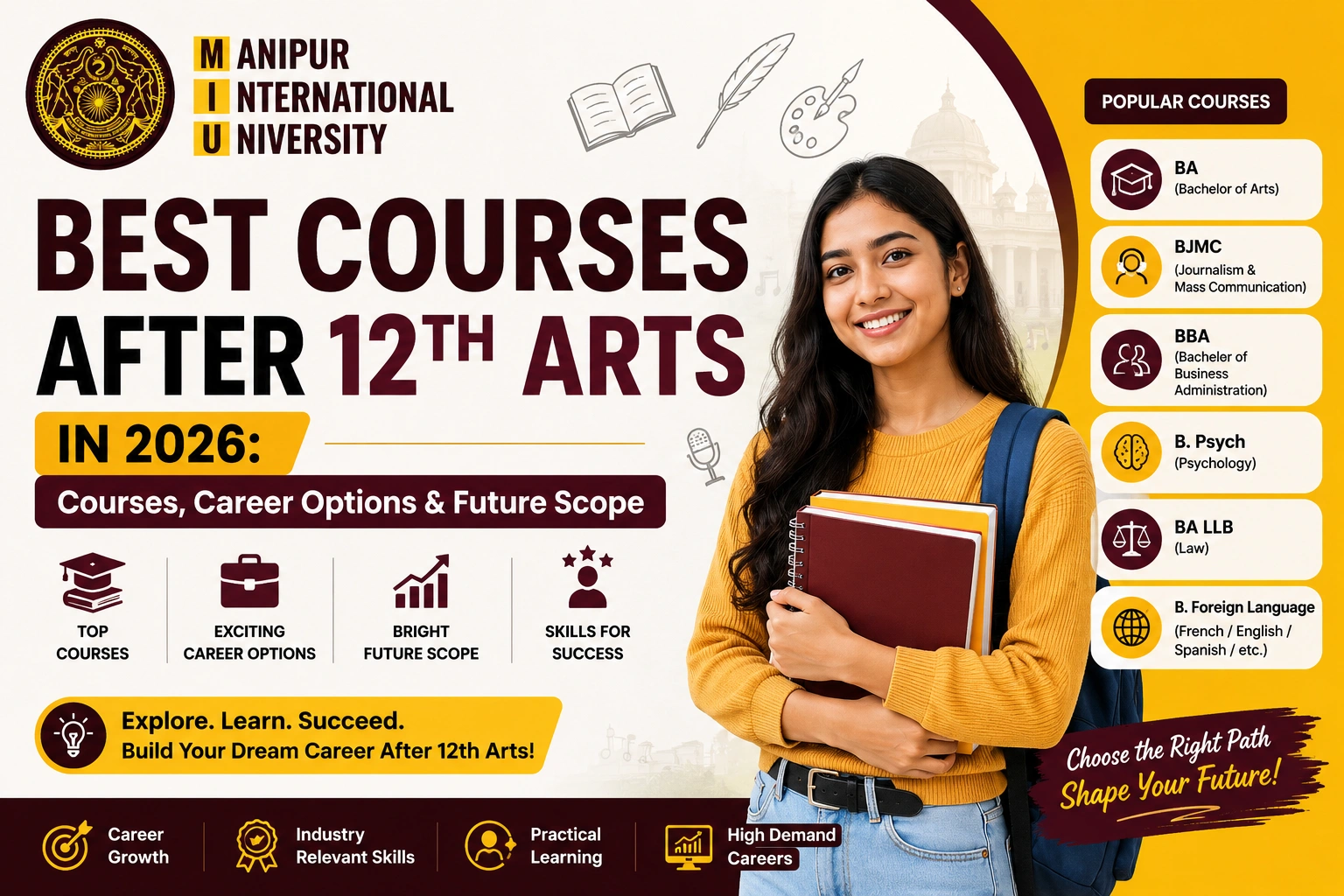
Choosing the right course after 12th Arts can help you build a strong foundation for your career. Arts students can choose from undergraduate degrees, professional programs, vocational education, diploma courses, and skill-based programs.
The best career-focused courses after 12th arts include Bachelor of Design (B.Des) for UI/UX and graphics, BA LLB integrated law programs, and Bachelor of Journalism and Mass Communication (BJMC), offering high growth in modern digital and corporate sectors.
This guide explains the best courses after 12th Arts, career options, future scope, and the factors you should consider before taking admission.
Which Are the Best Courses After 12th Arts?
The best courses after 12th Arts include BA, BBA, BA LLB, BJMC, BHM, BFA, BSW, design courses, digital marketing programs, vocational courses, and B.Voc programs.
Your interests should guide your choice. If you enjoy law, consider BA LLB. If you like business, consider BBA. If you enjoy media and communication, explore BJMC. If you prefer creative work, consider design or BFA. If you prefer practical and skill-based learning, explore a suitable vocational or B.Voc program.
No single course works best for every student. Compare the curriculum, eligibility, fees, practical training, institution, and career opportunities before making your decision.
Best Courses After 12th Arts: Quick Comparison
|
Course |
Best For |
Career Areas |
|
BA |
Students interested in humanities and social sciences |
Education, research, content, administration |
|
BBA |
Students interested in business and management |
Marketing, sales, HR, operations |
|
BA LLB |
Students interested in law |
Legal services, corporate law, legal research |
|
BJMC |
Students interested in media and communication |
Journalism, PR, digital media |
|
BHM |
Students interested in hospitality and tourism |
Hotels, resorts, hospitality |
|
BFA |
Students interested in visual and creative arts |
Fine arts, illustration, creative work |
|
BSW |
Students interested in social development |
NGOs, social services, community work |
|
B.Voc |
Students who prefer practical and skill-based learning |
Industry-focused roles and further education |
|
Design Courses |
Students with creative interests |
Graphic design, fashion, UI/UX |
|
Digital Marketing |
Students interested in online marketing |
SEO, content, social media, digital marketing |
This table provides a general overview. Your eligibility and career options will depend on the specific course and institution you choose.
1. Bachelor of Arts (BA)
A Bachelor of Arts (BA) gives Arts students a broad academic foundation and allows them to study subjects such as English, History, Political Science, Sociology, Psychology, Economics, or Geography.
Universities offer different BA combinations and specializations. Check the subjects available at your preferred institution before applying.
Why Should You Choose a BA?
A BA can suit students who want to:
- Study humanities or social sciences
- Build a foundation for higher education
- Prepare for certain competitive examinations
- Develop communication and analytical skills
- Explore careers in education, research, content, administration, or social services
What Careers Can You Pursue After a BA?
A BA can lead to careers in education, content, communication, research, administration, media, social services, and other fields, depending on your subject and additional skills.
Read More: Carrier option
You can explore:
- Education
- Content and communication
- Research
- Social services
- Administration
- Media
- Public-sector career pathways
- Higher education
You can also develop additional skills such as digital marketing, content writing, data tools, or foreign languages to expand your career options.
Bachelor of Business Administration (BBA)
BBA is a good option for Arts students who want to study business, management, marketing, human resources, or entrepreneurship.
A BBA program usually introduces students to areas such as:
- Marketing
- Finance
- Human resources
- Business communication
- Operations
- Entrepreneurship
What Can You Do After BBA?
BBA graduates can explore entry-level opportunities in marketing, sales, human resources, business development, operations, and customer management.
You can also use your BBA as a foundation for higher studies or entrepreneurship.
Before choosing a BBA program, check:
- Curriculum
- Specializations
- Internship opportunities
- Practical projects
- Faculty
- Total fees
Choose a program that combines classroom learning with practical exposure.
BA LLB
BA LLB is a suitable option for Arts students who want to build a career in law and legal services.
The program combines humanities subjects with legal education. Students who enjoy reading, research, analysis, communication, and argument may find this field suitable.
What Can You Do After BA LLB?
BA LLB graduates can explore legal practice, corporate legal services, legal research, compliance, policy-related work, and other legal career paths, subject to applicable professional requirements.
Before applying, check the current admission rules and eligibility requirements of the specific law program.
Bachelor of Journalism and Mass Communication (BJMC)
BJMC can suit Arts students who enjoy writing, storytelling, reporting, communication, media, or digital content.
Depending on the program, you may study:
- Journalism
- Media production
- Public relations
- Advertising
- Digital communication
- Content creation
What Careers Can You Pursue After BJMC?
BJMC graduates can explore careers in journalism, digital media, content creation, public relations, corporate communication, social media, and advertising.
When comparing BJMC programs, look for:
- Practical assignments
- Internships
- Media projects
- Industry exposure
- Digital media training
Bachelor of Hotel Management (BHM)
BHM can suit Arts students who want to work in hotels, resorts, tourism, travel, food services, or hospitality operations.
The hospitality industry values communication, customer service, teamwork, and practical experience.
What Careers Can You Pursue After BHM?
BHM graduates can explore opportunities in hotels, resorts, food and beverage operations, guest relations, event management, tourism, and hospitality operations.
Your specialization, practical training, communication skills, and work experience can influence your career growth.
Bachelor of Fine Arts (BFA)
BFA can suit Arts students who enjoy visual arts, creative expression, and artistic work.
Depending on the program, you may study:
- Painting
- Applied arts
- Sculpture
- Illustration
- Visual communication
- Other creative disciplines
What Can You Do After BFA?
BFA graduates can build careers in fine arts, illustration, visual communication, and other creative fields, depending on their specialization and portfolio.
Creative careers often require a strong portfolio. Build practical skills and showcase your best work while you study.
Bachelor of Social Work (BSW)
BSW can suit Arts students who want to work in social development, community programs, welfare organizations, or social services.
What Careers Can You Pursue After BSW?
BSW graduates can explore opportunities in NGOs, community development, social services, CSR-related work, welfare organizations, and social research.
Choose this field if you genuinely enjoy working with people and communities.
Best Professional Courses After 12th Arts
Arts students can choose professional courses in fields such as law, management, journalism, hospitality, and design, depending on the eligibility requirements.
Law
Law can suit students who enjoy research, reading, communication, and analytical thinking.
Management
Management programs can suit students who want to work in business, marketing, human resources, or entrepreneurship.
Journalism and Mass Communication
This field can suit students who enjoy media, writing, communication, public relations, and digital content.
Hospitality and Tourism
Hospitality and tourism can suit students who enjoy travel, customer service, hotels, and event-related work.
Design
Design programs can suit students who enjoy visual creativity, fashion, graphics, user experience, or communication design.
Before choosing a professional course, compare the curriculum, practical training, internship opportunities, fees, faculty, and career pathways.
Skill-Based Courses After 12th Arts
Skill-based courses can help Arts students develop practical abilities that they can use in specific career fields.
Depending on your interests, you can explore:
- Digital marketing
- SEO
- Graphic design
- Web design
- Data visualization
- Social media marketing
- Content creation
- UI/UX fundamentals
Which Skill-Based Course Should You Choose?
Choose a skill-based course according to the career you want to build.
For example:
- Choose digital marketing and SEO if you want to work in online marketing.
- Learn graphic design if you want to enter creative fields.
- Learn Excel and data visualization if you want to work with business data.
- Explore UI/UX if you enjoy design and technology.
- Learn web design if you want to understand website development.
Learning a single tool does not guarantee employment. Build projects, improve communication skills, and gain practical experience alongside technical skills.
Vocational Courses After 12th Arts
Vocational courses can suit Arts students who prefer practical learning and want to develop skills for a specific industry or occupation.
Depending on the program and eligibility, you can explore areas such as:
- Tourism and hospitality
- Retail management
- Banking and financial services
- Healthcare administration
- Media and communication
- Business operations
- Agriculture
- Other industry-focused vocational disciplines
The course structure and eligibility vary by institution and program. Always check the official admission requirements before applying.
Internal Link Opportunity:
Add a natural internal link to your detailed Vocational Courses After 12th guide here.
B.Voc After 12th Arts: Is It a Good Choice?
B.Voc can be a good choice for Arts students who want an undergraduate qualification with a practical and vocational learning focus.
B.Voc programs combine academic learning with vocational skills. The specialization determines the subjects and career direction.
Depending on the institution, students may find B.Voc programs in areas such as:
- Tourism and hospitality
- Retail management
- Banking and financial services
- Digital marketing
- Agriculture
- Other vocational disciplines
Why Do Students Choose B.Voc?
Students choose B.Voc because the program focuses on practical skills and career-oriented learning along with undergraduate education.
A B.Voc program may offer:
- Practical skill development
- Industry-focused learning
- Specialized knowledge
- Practical training or internships, depending on the program
- Opportunities for further education
The exact eligibility, curriculum, duration, and practical training depend on the specific institution and program.
Always check the latest official information before taking admission.
Internal Link Opportunity:
Add a natural internal link to What is a B.Voc Degree? here.
Diploma and Certificate Courses After 12th Arts
Diploma and certificate courses can help Arts students develop specific skills through shorter or focused learning programs.
You can explore courses in:
- Digital marketing
- Graphic design
- Web design
- Animation
- Photography
- Event management
- Travel and tourism
- Hospitality
- Office administration
- Computer applications
What Should You Check Before Choosing a Diploma Course?
Check:
- Course duration
- Eligibility
- Curriculum
- Practical training
- Certification
- Institution reputation
- Career relevance
A short-term course can help you develop a specific skill, but choose one that supports your long-term career plan.
Best Courses After 12th Arts Based on Your Interests
You should choose a course based on your interests, strengths, career goals, and preferred type of work.
If You Enjoy Creativity
Consider:
- Fine arts
- Graphic design
- Fashion
- Animation
- Photography
- Visual communication
If You Enjoy Business
Consider:
- BBA
- Management
- Digital marketing
- Entrepreneurship
- Retail management
If You Enjoy Communication
Consider:
- Journalism
- Mass communication
- Public relations
- Content creation
- Advertising
If You Enjoy Helping People
Consider:
- Psychology
- Social work
- Education
- Relevant counselling-related fields, subject to required qualifications
If You Prefer Practical Learning
Consider:
- B.Voc
- Vocational programs
- Diploma programs
- Industry-focused skill courses
Choose a course that matches your interests and abilities instead of choosing one only because it is popular.
Future Scope After 12th Arts
Arts students can build careers across education, law, media, management, digital marketing, hospitality, design, social services, research, and public-sector fields.
Your future scope depends on the course you choose, your specialization, the skills you develop, and the experience you gain.
Career Areas After 12th Arts
You can explore careers in:
- Education
- Media and journalism
- Digital marketing
- Content and communication
- Law
- Business and management
- Hospitality and tourism
- Design and creative industries
- Social services
- Public-sector careers
- Research and higher education
How Can You Improve Your Career Scope?
You can improve your career opportunities by combining your degree with practical skills and relevant experience.
Focus on:
- Communication skills
- Digital literacy
- Industry-specific skills
- Internships
- Practical projects
- Professional certifications
- Networking
- Continuous learning
Your degree provides the foundation, but the skills and experience you develop can influence your career growth.
Government Career Options After 12th Arts
Arts students can apply for government recruitment opportunities when they meet the eligibility requirements for a specific examination or post.
Government Opportunities After Class 12
Some government recruitment examinations accept candidates who have completed Class 12.
One example is SSC CHSL, subject to the eligibility requirements mentioned in the relevant recruitment notification.
Government Opportunities After Graduation
After completing a bachelor's degree, Arts students can become eligible for several graduate-level examinations, depending on the requirements of each recruitment process.
Examples include:
- UPSC Civil Services Examination
- SSC CGL
- IBPS PO and other banking examinations
- State-level competitive examinations
Eligibility rules can change. Always check the latest official notification before applying.
Important: Completing a degree does not guarantee selection in a government examination. Your preparation, eligibility, performance, and competition will affect the final result.
For detailed information, create a separate article targeting Government Jobs After 12th Arts and link it from this section.
How Should You Compare Courses After 12th Arts?
You should compare at least two or three suitable courses before choosing one.
Use these factors to compare your options:
|
Factor |
What You Should Check |
|
Interest |
Do you enjoy the subject or field? |
|
Eligibility |
Do you meet the admission requirements? |
|
Curriculum |
What will you learn during the course? |
|
Practical Learning |
Does the program include projects or practical training? |
|
Duration |
How long will you study? |
|
Fees |
Can you manage the total cost? |
|
Career Options |
What careers can the course support? |
|
Internship |
Does the program provide practical exposure? |
|
Higher Education |
Can you pursue further studies? |
|
Institution |
Does the college or university meet your expectations? |
Do not choose a course only because your friends or relatives recommend it. Research the course and understand where it can take you.
Common Mistakes Students Make After 12th Arts
Choosing a Course Because Friends Choose It
Do not choose a course simply because your friends selected it.
Your interests, strengths, and career goals may differ from theirs.
Choosing Only for Salary
Do not select a course only because someone promises a high salary.
Your income depends on your skills, experience, specialization, industry, location, and employer.
Ignoring Eligibility
Always check the latest eligibility requirements before applying.
Different courses and institutions may have different admission rules.
Not Checking the Curriculum
Read the course syllabus before taking admission.
The course name alone does not tell you what you will learn.
Ignoring Practical Experience
Choose opportunities that help you gain practical experience whenever possible.
Projects and internships can help you apply what you learn.
Believing Guaranteed Placement Claims
Treat guaranteed placement claims with caution.
No course can guarantee a job for every student. Check placement information and look for transparent data.
Choosing Without Understanding the Career Path
Research the career options connected with the course before enrolling.
Understand the skills and qualifications that employers usually expect.
Career Roadmap After 12th Arts
You can follow a simple process to choose a suitable course after 12th Arts.
Step 1: Identify Your Interests
Write down the subjects and activities you enjoy.
Step 2: Understand Your Strengths
Think about your communication, creativity, analytical thinking, problem-solving, and people skills.
Step 3: Shortlist Career Areas
Select three to five career fields that match your interests and strengths.
Step 4: Find Relevant Courses
Research degree, professional, diploma, and vocational programs connected with those fields.
Step 5: Compare Your Options
Compare eligibility, curriculum, fees, duration, practical training, and career opportunities.
Step 6: Research Institutions
Check the curriculum, faculty, facilities, practical exposure, internships, and official recognition or affiliation where applicable.
Step 7: Build Additional Skills
Learn communication, digital literacy, problem-solving, and other skills that support your chosen career.
Step 8: Make Your Decision
Choose the course that fits your goals, abilities, interests, and circumstances.
Course Selection Checklist
Before taking admission, ask yourself:
- Do I understand what I will study?
- Does this course match my interests?
- Does it suit my strengths?
- Do I meet the eligibility requirements?
- Have I compared at least two or three courses?
- Have I checked the curriculum?
- Have I researched career opportunities?
- Have I checked the total fees?
- Have I considered the course duration?
- Does the program provide practical learning?
- Have I checked internship opportunities?
- Have I verified official recognition or affiliation where relevant?
- Do I understand my options after completing the course?
Frequently Asked Questions
Which is the best course after 12th Arts?
The best course after 12th Arts depends on your interests and career goals. Popular options include BA, BBA, BA LLB, BJMC, BHM, BFA, BSW, design courses, digital marketing, vocational programs, and B.Voc.
Which course is best for Arts students who want a high salary?
No course can guarantee a high salary. Your earning potential depends on your skills, specialization, experience, industry, location, and employer. Choose a field that matches your strengths and offers realistic career opportunities.
Can Arts students pursue professional courses?
Yes, Arts students can pursue several professional courses if they meet the required eligibility criteria. Options may include law, management, journalism, hospitality, design, digital marketing, and other career-focused programs.
Is B.Voc good after 12th Arts?
B.Voc can suit Arts students who want practical, skill-based undergraduate education. Check the specialization, curriculum, eligibility, practical training, and career opportunities before choosing a program.
Can Arts students get government jobs?
Yes, Arts students can apply for government jobs when they meet the eligibility requirements for the specific post or examination. Some opportunities accept 12th-level qualifications, while others require graduation.
Which computer course is best after 12th Arts?
The best computer course depends on your career goal. You can learn digital marketing and SEO for online marketing, graphic design for creative work, Excel and data visualization for business roles, or UI/UX and web design for technology-related careers.
Should I choose a degree or vocational course?
Choose a degree or vocational course based on your career goals and preferred learning style. A degree may provide a broader academic foundation, while vocational education often focuses more on practical and occupational skills.
What should I check before taking admission?
Check the eligibility, curriculum, fees, duration, institution, practical training, internship opportunities, recognition or affiliation where applicable, and career pathways before taking admission.
Final Answer: Which Course Is Best After 12th Arts?
The best course after 12th Arts is the one that matches your interests, strengths, career goals, and preferred way of learning.
If you enjoy humanities and social sciences, consider BA. If you want to study business, consider BBA. If you want to enter law, explore BA LLB. If you enjoy media and communication, consider BJMC. If you prefer creative work, explore BFA or design. If you want practical and career-focused learning, consider B.Voc or another suitable vocational program.
Before making your final decision, compare the course curriculum, eligibility, fees, practical training, institution, and career pathways.
Your Class 12 stream does not decide your entire career. The course you choose, the skills you develop, and the experience you gain will shape your professional journey.