
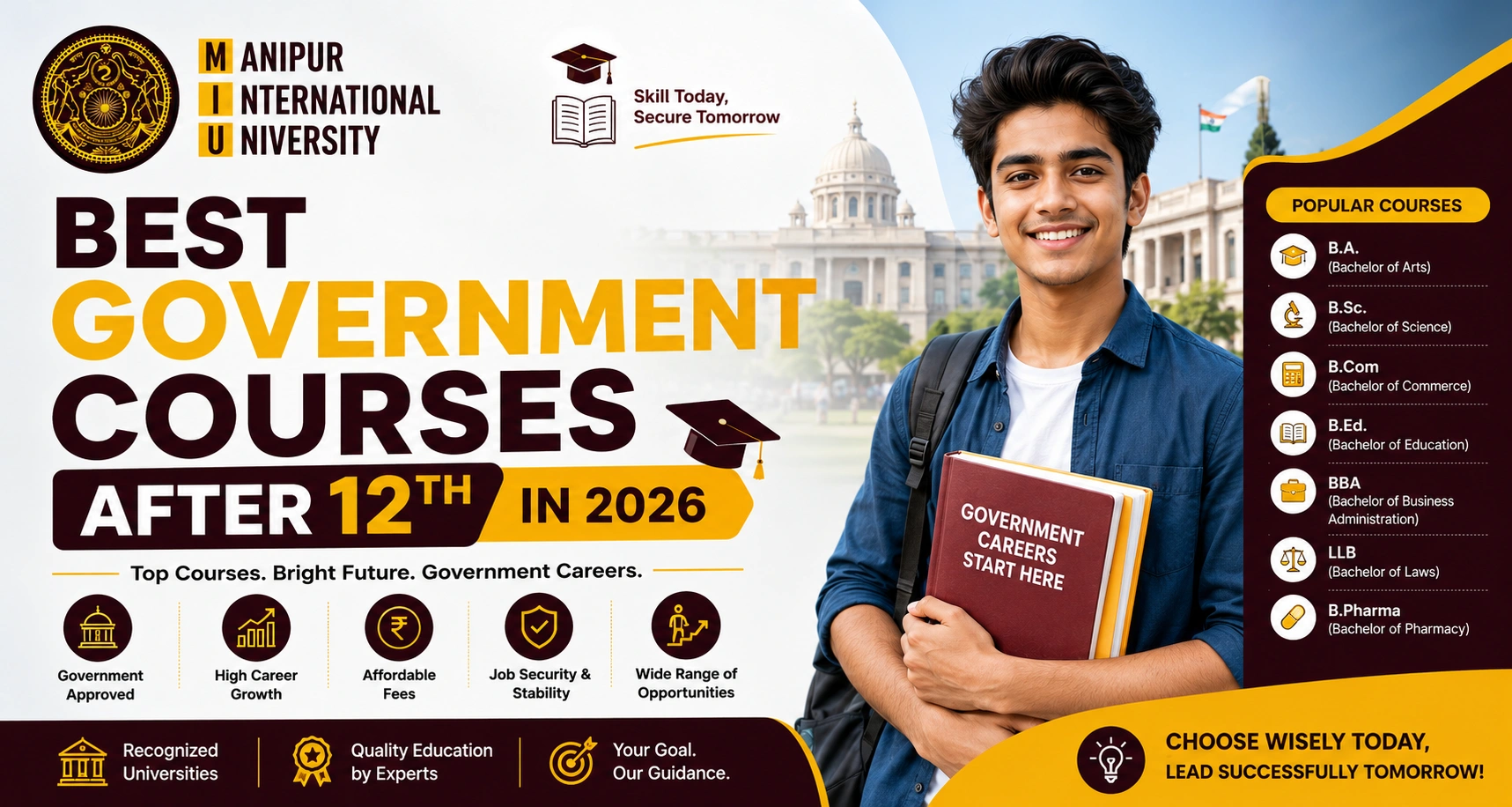
The best government courses after 12th depend on your academic stream, career goal, eligibility, and whether you want higher education, skill training, or a pathway toward government-job eligibility. Popular options in India include degree programs at government colleges, polytechnic diplomas, ITI trade courses, and skill-based programs like B.Voc. There is no single "best" choice for everyone. The right course is the one that matches your stream, interests, and long-term plans.
What Are Government Courses After 12th?
Government courses after 12th are education or training programs offered by government institutions, or programs that carry government recognition or support. They are not the same as courses designed only to help you clear government job exams.
When students search for this term, they usually mean one of a few different things. Understanding these differences helps you choose correctly.
Here are the common meanings you may come across:
- Courses at government institutions: Programs offered by government colleges, universities, polytechnics, or ITIs.
- Government-recognized programs: Courses approved by bodies like the UGC or AICTE, even if the college is private.
- Government-supported training: Skill-development programs run under central or state government schemes.
- Job-eligibility courses: Qualifications that may make you eligible to apply for certain government recruitment, based on official criteria.
A government course and a government job preparation course are two different things. Studying at a government college does not automatically lead to a government job. Government employment depends on the eligibility rules and recruitment process of the concerned department.
Best Government Courses After 12th
The best government courses after 12th fall into five broad categories: degree programs, diploma programs, ITI/training pathways, skill-based programs, and sector-specific courses. Each suits a different type of student and career goal.
You do not need to pick from a long, confusing list. Instead, focus on the category that fits your stream and interest. Here is a simple breakdown.
Degree programs work well if you want higher education and long-term flexibility. Programs like BA, B.Sc, B.Com, or professional degrees at government colleges open doors to many career paths. Important consideration: admission is often merit-based and competitive.
Diploma programs, such as polytechnic diplomas, suit students who want practical, job-oriented education in less time than a full degree. They focus on technical skills.
ITI and training pathways are ideal if you prefer hands-on trade skills and quicker entry into technical work.
Skill-based programs, like B.Voc degrees, combine practical training with academic learning. They suit students who want job-ready skills without giving up the option of higher studies.
Sector-specific programs target fields like healthcare, agriculture, banking, or safety.
|
Course/Pathway |
Suitable For |
Study Focus |
Possible Career Direction |
|
Degree (BA/B.Sc/B.Com) |
Students wanting higher education |
Academic + theory |
Higher studies, public and private sectors |
|
Polytechnic Diploma |
Practical technical learners |
Applied technical skills |
Technical roles, junior engineering paths |
|
ITI Trade Course |
Hands-on skill seekers |
Trade-based practical work |
Skilled technical work |
|
B.Voc (Skill Degree) |
Job-ready + degree seekers |
60% practical, 40% theory |
Industry roles, self-employment, higher studies |
|
Sector Programs (Health, BFSI, Agriculture) |
Field-focused students |
Specialized skills |
Sector-specific careers |
Takeaway: Match the category to your goal first, then explore specific courses within it.
Best Courses After 12th for Government Jobs
There is no single course that is universally best for government jobs after 12th. The right qualification depends on the specific government recruitment opportunity you want to pursue and its official eligibility criteria.
Government recruitment in India happens at many levels. Some roles need only a 12th pass. Others require a graduation degree, a diploma, or a technical qualification. So your course choice should follow the type of role you are targeting.
Here are common pathways students consider:
- Graduation-based opportunities: A bachelor's degree can make you eligible for a wide range of recruitment exams. Degrees like BA, B.Sc, and B.Com are popular starting points.
- Technical qualifications: Engineering diplomas or technical degrees may help you apply for technical government posts.
- Diploma and ITI pathways: Certain trade and technical roles accept ITI or diploma holders, depending on the notification.
- Banking-related qualifications: Commerce and finance-related education can support banking-sector recruitment eligibility.
- Sector-specific education: Healthcare, agriculture, or safety-related qualifications can help for roles in those departments.
Remember, the right qualification can make you eligible to apply. It does not guarantee selection. Recruitment usually involves written exams, interviews, or skill tests. Always check the official recruitment notification for exact requirements.
Government Courses After 12th for Arts Students
Arts and Humanities students can pursue strong government-recognized courses after 12th, including BA in subjects like political science, history, economics, public administration, sociology, and languages. These degrees suit students who enjoy reading, analysis, and social subjects.
An Arts background is flexible. Many students choose a BA and later prepare for graduate-level recruitment exams. Others move into fields like law, teaching, journalism, or social work.
Popular directions for Arts and Humanities students include:
- BA in Political Science or Public Administration: Useful for students interested in governance and civil services later.
- BA in Economics: Helpful for analytical and finance-linked career paths.
- Integrated Law (BA LLB): Suits students aiming for legal careers.
- BA in Languages or Journalism: Good for media, content, and communication roles.
Some students search for government courses after 12th arts with high salary. It is important to be realistic here. Salary depends on the actual job role, recruitment level, and experience, not on the course name alone. A degree simply builds the foundation.
Note for girls and all students: Arts pathways are open to everyone and offer many further-study and career options.
Government Courses After 12th for Science Students
Science students have wide options after 12th, and the right choice depends on whether you studied PCM (Physics, Chemistry, Maths) or PCB (Physics, Chemistry, Biology). Both streams open different government-recognized courses and career directions.
Your subject combination shapes your best-fit options:
For PCM students:
- B.Sc in Physics, Maths, or Computer Science
- Engineering diplomas or B.Tech at government institutions
- Data, IT, and technology-focused programs
For PCB students:
- B.Sc in Biology, Zoology, Botany, or Microbiology
- Paramedical and allied health programs
- Nursing and healthcare-linked courses
For PCMB students: You keep options open across both technical and medical-linked paths.
Science degrees can also support eligibility for various government recruitment exams later, from technical posts to general graduate-level roles. Students often ask about government courses after 12th science with high salary. Again, earnings depend on the role, organization, and recruitment level, not just the qualification. Focus first on a subject you enjoy and can study well.
Government Courses After 12th for Commerce Students
Commerce students can pursue government-recognized courses after 12th such as B.Com, BBA, and finance or banking-related programs. These suit students comfortable with numbers, accounts, business, and economics.
A commerce background is especially useful for banking, accounting, and finance career paths. Here are common options:
- B.Com (General or with specialization): A strong base for finance, accounting, and further studies.
- B.Com in Banking and Finance: Directly relevant for students interested in the banking sector.
- BBA: Good for management and business-oriented careers.
- Professional pathways: Some students later pursue accounting or finance certifications alongside their degree.
Students often look for government banking courses after 12th commerce. A commerce degree can support eligibility for banking-sector recruitment exams, but selection still depends on clearing the required exam and meeting official criteria. Commerce pathways are open to all students, including girls, and offer solid career and higher-study options.
Free Government Courses After 12th
Not all government courses after 12th are free. However, some government-funded or government-supported training programs may be available at little or no cost, depending on the scheme, institution, eligibility, and current availability.
"Free government courses" usually means skill-development or training programs run under central or state government schemes. These often focus on employable skills rather than full degrees.
Here is what students should understand:
- Government-funded training: Some skill schemes offer short-term training with low or no fees for eligible candidates.
- Skill-development programs: These are usually sector-specific and time-bound.
- Eligibility rules apply: Free or subsidized seats often depend on category, income, age, or location.
- Availability changes: Seats, schemes, and funding vary each year.
Because these details change often, always verify current information on the official government portal or scheme website before applying. Do not assume every government-linked course is free.
ITI Courses After 12th
Yes, students can pursue ITI courses after 12th. ITI stands for Industrial Training Institute, and these programs offer practical, trade-based training that prepares students for skilled technical work.
ITI courses focus on hands-on learning rather than heavy theory. They are shorter than degrees and suit students who want to build a specific technical skill quickly.
Popular trade categories include:
- Electrician
- Fitter
- Mechanic (motor vehicle)
- Welder
- Draughtsman
- Computer operator and programming assistant
ITI qualifications can relate to employment in technical fields, and certain government recruitment notifications accept ITI trade certificates for relevant posts. However, eligibility depends entirely on the official notification. An ITI certificate supports your application; it does not guarantee a job. It is a practical starting point for technical careers.
Best Diploma Courses for Government Jobs
Diploma courses can support eligibility for certain government jobs, especially technical roles, but the exact requirement always depends on the recruitment notification. Popular options include polytechnic diplomas in engineering fields.
First, understand the difference between qualifications:
- Diploma: A shorter, skill-focused qualification, often 2–3 years.
- Degree: A full undergraduate qualification, usually 3–4 years, with broader eligibility for many exams.
- Recruitment eligibility: Each government post lists whether it accepts a diploma, a degree, or both.
Useful diploma directions include:
- Engineering diplomas (civil, mechanical, electrical) for technical posts
- Computer and IT diplomas for technical support roles
- Skill-focused diplomas in healthcare, agriculture, or safety
Do not assume a diploma alone leads to a government job. Some posts prefer degree holders, while others accept diploma holders. Always read the official eligibility criteria carefully before applying.
How to Choose the Right Course After 12th?
The right course after 12th is the one that matches your stream, career goal, eligibility, budget, and long-term plans. Use a clear checklist instead of following trends or peer pressure.
Work through these ten points before you decide:
- Academic stream: Choose a course that fits your Arts, Science, or Commerce background.
- Career goal: Know what kind of work you want, even broadly.
- Course eligibility: Confirm you meet the minimum marks and subject requirements.
- Course duration: Decide how many years you can commit to studying.
- Fees: Compare costs and check for scholarships or funding.
- Recognition: Prefer courses recognized by bodies like UGC or AICTE.
- Practical training: Check if the course includes hands-on learning or internships.
- Career scope: Look at the range of paths the course can lead to.
- Further education: Make sure the course keeps your higher-study options open.
- Government recruitment eligibility: If you want government roles, check what qualification the target posts require.
Common mistake to avoid: Choosing a course only because it sounds impressive. Match it to your real interests and goals instead.
Government Courses vs Courses for Government Jobs
A government course is education offered by or recognized by the government. A course for government job preparation is training aimed at helping you clear a specific recruitment exam. These serve different purposes, and mixing them up causes confusion.
Here is a simple comparison:
|
Aspect |
Government Course |
Course for Government Job Preparation |
|
Purpose |
Provide education or skills |
Prepare for a specific recruitment exam |
|
Qualification |
Gives a degree, diploma, or certificate |
Usually no formal degree |
|
Recruitment |
Does not directly hire you |
Helps you attempt selection exams |
|
Examples |
B.Sc at a government college, polytechnic diploma |
Exam coaching programs |
|
Common myth |
"It guarantees a government job" |
"It replaces the need for a qualification" |
The key misunderstanding: Many students think finishing a government course automatically means a government job. It does not. A government course builds your qualification. A government job still requires clearing the official recruitment process. Understanding this saves you from wrong decisions.
Career Opportunities After Government-Oriented Courses
Career-oriented courses after 12th can open several directions, including further studies, private-sector roles, self-employment, and eligibility for government recruitment. Actual outcomes vary from student to student.
Your career results do not depend only on the course. They depend on many factors working together:
- Qualification: The level and relevance of your course
- Skills: How well you apply what you learned
- Recruitment exams: Your performance in selection processes
- Vacancies: The number of openings available at the time
- Experience: Practical work you gain over the years
- Eligibility: Meeting official criteria for each opportunity
For example, a B.Voc graduate might join industry, freelance, start a small business, or pursue higher studies. A degree holder might prepare for graduate-level recruitment. No path promises a fixed result. Focus on building strong skills and a clear plan, and keep checking official notifications for opportunities that match your qualification.
Government Courses and Vocational Programs at MIU
Manipur International University (MIU) is an autonomous statutory international university established, recognized, and institutionally accredited by the State Government of Manipur. Its vocational vertical offers UGC-recognized B.Voc degrees that blend practical skills with academic learning.
B.Voc is a skill-based undergraduate degree introduced under UGC guidelines. It is recognized at par with other bachelor's degrees for higher education and competitive examinations, while focusing on job-ready training.
Students exploring career-focused, skill-based education can look at relevant Vocational MIU programs such as:
- IT/ITES/Software Development and Applied Computer Technology for technology-focused learners
- Banking Finance Services and Insurance (BFSI) for commerce and finance interests
- Healthcare and Paramedical programs for students drawn to allied health fields
- Electrical Skills and Automotive Skills for hands-on technical trades
- Agriculture & Rural Development for rural and farming-linked careers
- Fire Technology & Industrial Safety Management for safety-focused roles
These programs suit students who want practical skills alongside a recognized degree, keeping both employment and higher-study options open.
Students looking for career-focused vocational education can explore the relevant programs at Vocational MIU and check the latest eligibility, course and admission information on the official website.
Conclusion
Choosing among government courses after 12th comes down to your stream, career goal, eligibility, and long-term plans. Remember the key difference: a government course gives you a qualification, while a government job still requires clearing an official recruitment process. No course guarantees a job or a fixed salary.
Start by shortlisting two or three courses that match your interests. Check their eligibility and recognition, then verify current details on official sources. A recognized, skill-focused course keeps both employment and higher-study doors open, giving you a strong and flexible start.