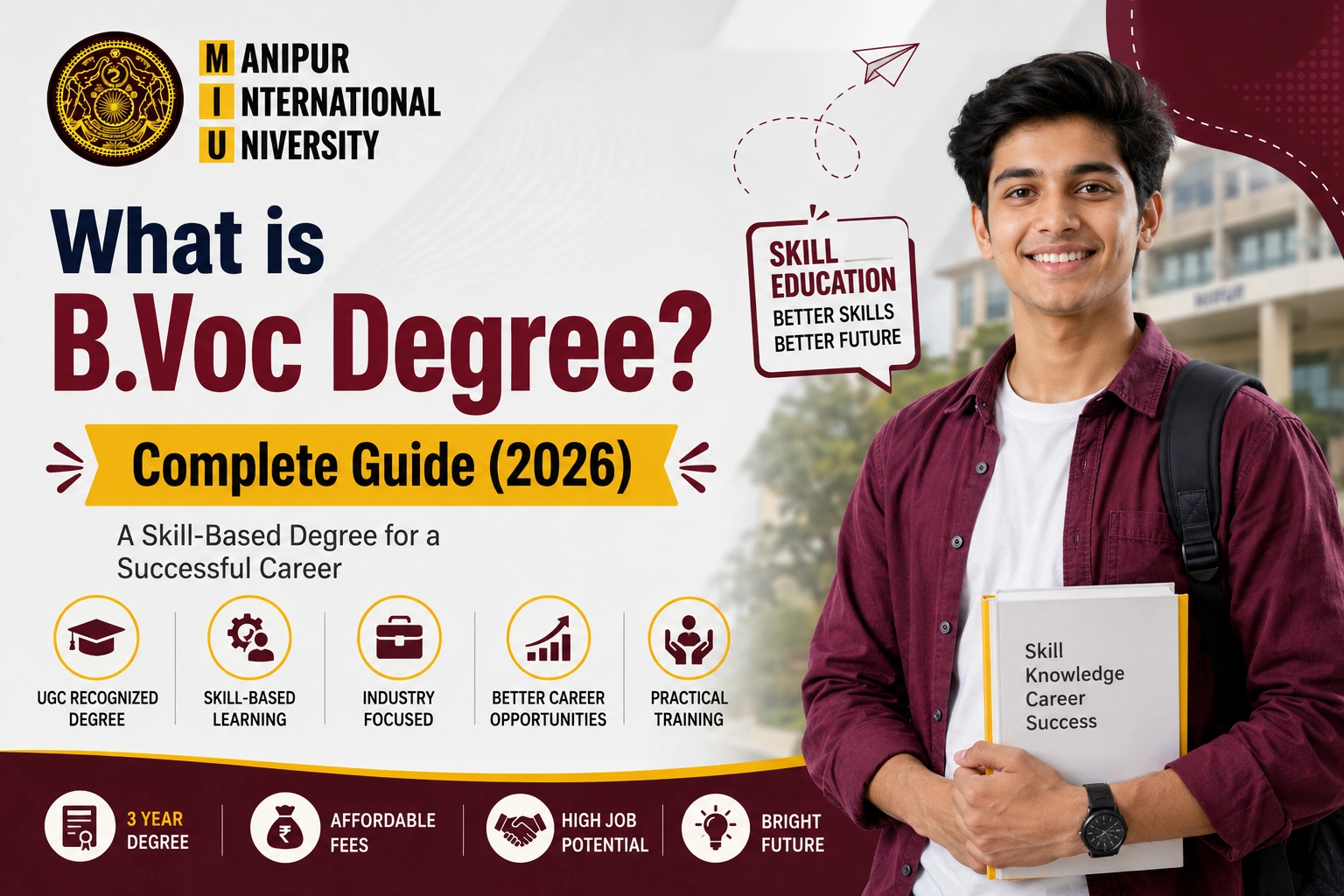
You've finished Class 12 and now everyone around you is pushing the same three options — B.Com, B.Sc, or B.A. But what if you want a degree that combines academic learning with practical, job-focused skills?
That's where a B.Voc degree can be a useful option. B.Voc stands for Bachelor of Vocation. It is a three-year undergraduate bachelor's degree that combines academic education with vocational and skill-based learning. The programme is designed for students who want to build practical skills in a specific sector while earning a bachelor's degree.
Unlike a traditional general degree, a B.Voc programme focuses strongly on applied learning and industry-oriented skills. The exact practical training, subjects, internships and course structure depend on the specialization and university.
What is B.Voc Degree?
A B.Voc (Bachelor of Vocation) is a three-year undergraduate bachelor's degree specified by the University Grants Commission (UGC). It combines academic education with vocational and skill-based learning in a chosen field. Depending on the programme, students may receive practical training, projects, internships and industry exposure. After completing the degree, students can explore jobs, higher education, entrepreneurship or other career paths based on their specialization and eligibility. The key difference from a general degree is its strong focus on vocational and career-oriented learning.
Read More:B Voc Course Details
Quick Facts Table
|
Detail |
Information |
|
Full Form |
Bachelor of Vocation |
|
Level |
Undergraduate Bachelor's Degree |
|
Duration |
Minimum 3 years / 6 semesters |
|
Entry Qualification |
Class 12 (10+2) or equivalent |
|
Main Focus |
Vocational skills + academic learning |
|
Practical Learning |
Depends on specialization and university |
|
Exit Options |
May be available under applicable academic regulations |
|
Fees |
Varies by university and specialization |
|
Starting Salary |
Depends on role, skills, location and employer |
|
Higher Studies |
M.Voc, MBA, PG programmes and other eligible courses |
What is B.Voc Degree?
B.Voc degree is a three-year undergraduate bachelor's programme that combines academic education with vocational and industry-oriented skill development. Students learn concepts related to their chosen specialization and may also complete practical sessions, projects, training or internships where the programme provides them.
The University Grants Commission (UGC) officially specifies B.Voc as Bachelor of Vocation, an undergraduate bachelor's degree with a minimum duration of three years and 10+2 as the entry qualification.
The main idea behind B.Voc is simple: students should develop both knowledge and practical skills related to a particular field.
For example, a student pursuing a B.Voc programme in an IT-related field may learn programming, databases, web technologies and other technical skills along with academic subjects. A student in hospitality may learn hotel operations, customer service and related practical skills.
That's what B.Voc meaning comes down to in practice: a bachelor's degree designed to connect academic learning with vocational and career-focused skills.
B.Voc Full Form
The B.Voc full form is Bachelor of Vocation.
"Vocation" refers to a profession, occupation or type of work that requires specific knowledge and skills. A B.Voc programme follows this idea by combining academic education with vocational learning in a chosen field.
Students can choose a specialization according to their interests, eligibility and career goals. The available specializations and course structure vary between universities.
What is B.Voc Course?
A B.Voc course combines academic education with vocational and practical skill development. Students study subjects related to their chosen specialization and may also complete practical sessions, projects, industry exposure or internships depending on the programme structure.
The exact balance between theoretical and practical learning can vary by university and specialization. Therefore, there is no need to assume that every B.Voc programme follows one fixed 60:40 practical-to-theory ratio.
The key difference is the career-oriented nature of the curriculum. Instead of focusing only on theoretical knowledge, B.Voc programmes are designed to help students develop skills that they can apply in their chosen field.
By graduation, students may have academic knowledge along with practical projects, training or internship experience that can support their entry into the job market.
Read More: B Voc course
Is B.Voc a Degree Course?
Yes. B.Voc is an undergraduate bachelor's degree, not a diploma or certificate course.
The University Grants Commission officially specifies B.Voc (Bachelor of Vocation) as a bachelor's degree at the undergraduate level, with a minimum duration of three years and 10+2 as the entry qualification.
This means B.Voc is a graduation-level qualification. However, whether a B.Voc degree satisfies the eligibility requirement for a particular government job, competitive examination, professional role or higher-study programme depends on the rules of the relevant authority or institution.
For this reason, students should always check the latest eligibility notification before applying for a specific job, examination or higher education programme.
Do This Before You Enroll
Before taking admission, verify the recognition status of the university and the specific programme. Also check the latest eligibility rules if your goal is a government job, competitive examination or a particular higher-study programme.
B.Voc Degree Details
Duration and Exit Options
A B.Voc degree generally has a minimum duration of three years after Class 12. The programme is normally structured across six semesters, although the exact academic structure can vary by institution.
Under applicable multiple-entry and multiple-exit frameworks, students may have an opportunity to exit at different stages with the qualification specified by the applicable regulations and programme structure.
|
Stage |
Possible Qualification |
|
After 1 year |
Undergraduate Certificate |
|
After 2 years |
Undergraduate Diploma |
|
After 3 years |
Bachelor's Degree (B.Voc) |
Students should confirm the exact exit options, credits and re-entry rules with their university before admission.
Eligibility Requirements
The basic entry qualification for B.Voc is generally Class 12 (10+2) or an equivalent qualification. Specific requirements can vary according to the university and specialization.
|
Requirement |
Details |
|
Minimum Qualification |
Class 12 (10+2) or equivalent |
|
Stream |
Depends on the university and specialization |
|
Minimum Marks |
Varies by institution and programme |
|
Required Subjects |
May vary for specific specializations |
|
Age Limit |
Check the admission rules of the university |
|
Selection |
Merit, direct admission or entrance process may apply |
Students should check the latest admission notification of their chosen university because eligibility requirements can differ between programmes.
Admission Process
Most B.Voc admissions follow a straightforward process:
1. Visit the college website or admission office and check the application process.
2. Submit the required documents, such as Class 12 marksheet, passing certificate and identity proof.
3. Complete the selection process, which may be based on merit, direct admission or an entrance test depending on the institution.
4. Complete the fee payment and admission formalities after receiving confirmation.
Note: Some universities may conduct centralized admissions. Always check the exact process and deadlines for your target university.
Course Structure
The exact B.Voc course structure depends on the university and specialization. A typical programme may include:
• Skill-based subjects related to the chosen specialization
• General education subjects
• Practical or laboratory sessions
• Projects and assignments
• Industry exposure or field visits
• Internship or workplace training, where included in the programme
• Practical and written assessments
The purpose is to combine academic understanding with skills that students can apply in their chosen field.
B.Voc Course Subjects
Your exact B.Voc subjects depend on your specialization and university. An IT-focused B.Voc programme will have different subjects from a programme in healthcare, hospitality, design or banking.
|
Subject Category |
What It Covers |
|
Core Skill Subjects |
Field-specific tools, software, techniques and concepts |
|
Practical Training |
Supervised practical activities related to the specialization |
|
General Education |
Communication, basic IT and other academic subjects |
|
Soft Skills |
Teamwork, communication, presentation and workplace skills |
|
Internship |
Industry or workplace exposure where included |
|
Project Work |
Academic, practical or industry-related projects |
Example — B.Voc in an IT-Related Field
Students may study areas such as programming fundamentals, web technologies, databases, software tools and other technical subjects. The exact subjects and internship structure depend on the university and specialization.
Popular B.Voc Specializations
Choose your specialization based on your interest, skills and the career opportunities available in your target industry.
|
Specialization |
Duration |
Key Career Roles |
|
Software Development / IT |
3 yrs |
Junior Developer, QA Tester, IT Support |
|
Digital Marketing |
3 yrs |
SEO Executive, Social Media Executive |
|
Healthcare & Paramedical |
3 yrs |
Healthcare Support, Lab-related Roles |
|
Banking & Finance |
3 yrs |
Banking Associate, Accounts Executive |
|
Interior Design |
3 yrs |
Design Assistant, Space Planner |
|
Retail Management |
3 yrs |
Store Executive, Store Manager |
|
Hospitality & Tourism |
3 yrs |
Front Desk Executive, Tour Coordinator |
|
Automobile Technology |
3 yrs |
Technician, Service Executive |
Before picking a specialization, search for current job listings in that field in your target city. Look at the skills employers request, the number of openings and the career progression. This can help you choose a specialization based on actual market demand.
Benefits of B.Voc Degree
A B.Voc degree can offer several advantages for students who prefer practical and career-focused learning.
• Practical skill development: Students can develop skills related to their chosen specialization through practical activities, projects or training.
• Industry-oriented learning: The curriculum focuses on vocational and occupational skills.
• Early career preparation: Students can build relevant skills and experience before entering the job market.
• Portfolio development: Projects and practical work can help students demonstrate their abilities to employers.
• Flexible career paths: Depending on the specialization, graduates can explore jobs, higher education, freelancing or entrepreneurship.
• Bachelor's degree qualification: B.Voc is specified by UGC as an undergraduate bachelor's degree.
Real example: A student pursuing B.Voc in Digital Marketing may work on SEO, social media, content or advertising projects during practical training. These projects can help the student build a portfolio before applying for jobs.
B.Voc Degree Value in India
The B.Voc degree is a bachelor's degree specified by the UGC. The UGC specification identifies B.Voc as Bachelor of Vocation at the undergraduate level with a minimum duration of three years.
The practical value of the degree, however, depends on the specialization, institution, curriculum, practical exposure and the career path you choose.
|
Factor |
What It Means for You |
|
UGC Degree Specification |
B.Voc is specified as an undergraduate bachelor's degree |
|
Practical Learning |
Focuses on vocational and skill-based education |
|
Career Options |
Depend on your specialization and skills |
|
Higher Studies |
Depend on the eligibility rules of the next programme |
|
Employer Acceptance |
Can vary by industry, role and employer |
|
Career Growth |
Depends on experience, skills and specialization |
Before choosing a B.Voc programme, look beyond the degree name. Check the syllabus, practical facilities, internship opportunities, faculty, placement record and career outcomes of the specific university.
Is B.Voc Equivalent to Graduation, B.Sc, or B.Tech?
Is B.Voc Equivalent to Graduation?
Yes. B.Voc is an undergraduate bachelor's degree. UGC officially specifies B.Voc (Bachelor of Vocation) as a bachelor's degree with a minimum duration of three years.
However, eligibility for a particular government job, competitive examination or higher-study programme depends on the rules issued by the relevant authority. Always check the latest notification before applying.
Is B.Voc Equivalent to B.Sc?
B.Voc and B.Sc are both bachelor's-level programmes, but they have different academic focuses.
B.Sc generally focuses on academic and scientific study, while B.Voc focuses more strongly on vocational and applied skills in a chosen field.
Neither degree is automatically better than the other. The right option depends on your career goals and the specialization you want to study.
Is B.Voc Equivalent to B.Tech?
No. B.Voc and B.Tech are different degrees.
B.Tech is an engineering and technology degree, while B.Voc is a vocational bachelor's degree. A B.Voc qualification should not be presented as an engineering degree or as a substitute for B.Tech where a specific engineering qualification is required.
|
Feature |
B.Voc |
B.Sc |
B.Tech |
|
Degree Level |
Bachelor's |
Bachelor's |
Bachelor's |
|
Typical Duration |
3 years min |
Usually 3 yrs |
Usually 4 yrs |
|
Main Focus |
Vocational & practical |
Science & academic |
Engineering & tech |
|
Career Direction |
Sector-specific roles |
Science & research |
Engineering roles |
|
Higher Studies |
Depends on eligibility |
Depends on eligibility |
Depends on eligibility |
The best choice depends on the career you want to build.
Is B.Voc Better Than BBA?
Neither degree is universally better. The right choice depends on the type of career you want.
BBA provides a broad foundation in business and management. It may suit students interested in management, business operations, entrepreneurship or an MBA.
B.Voc focuses on vocational and field-specific skills. It may suit students who want practical learning and a career connected to a particular sector.
|
Factor |
B.Voc |
BBA |
|
Primary Focus |
Industry-specific vocational skills |
Business and management |
|
Practical Learning |
Depends on programme |
Depends on university |
|
Best For |
Specialized career skills |
Business & management |
|
Higher Studies |
M.Voc, MBA & other |
MBA & other |
|
Career Direction |
Depends on specialization |
Business & management |
Ask yourself: Do you want to build specialized skills for a particular sector, or do you want a broader foundation in business and management? Your answer can help you decide between B.Voc and BBA.
B.Voc Salary in India
Your B.Voc salary in India depends on several factors, including your specialization, job role, skills, experience, employer and location.
There is no single salary figure for all B.Voc graduates because a graduate in software development may have a very different career path from someone working in healthcare, hospitality, retail or design.
Factors That Affect B.Voc Salary
|
Factor |
Impact on Salary |
|
Specialization |
Some sectors have higher demand for specific skills |
|
Job Role |
Salary varies between entry-level and specialized roles |
|
Skills |
Technical and practical skills can improve job opportunities |
|
Experience |
Salary usually increases with relevant experience |
|
Location |
Pay can vary between cities and regions |
|
Employer |
Company size and industry can affect compensation |
|
Portfolio |
Demonstrable projects can strengthen your job profile |
B.Voc Salary for Freshers
Freshers normally begin with entry-level positions related to their specialization. Instead of choosing a B.Voc course only because of a promised salary, compare current job openings, required skills and actual placement records.
For example, an IT graduate may start in a junior technology role, while a hospitality graduate may begin in an operational or guest-service role. Their salary expectations will naturally be different.
How to Increase Your Salary After B.Voc
• Build strong practical skills
• Complete relevant internships
• Create a professional portfolio
• Learn tools used in your industry
• Add relevant certifications
• Improve communication and interview skills
• Gain experience in your chosen specialization
Important: Salary figures published by colleges and job portals can change over time. Always check recent job listings and placement data instead of relying on one fixed salary range.
B.Voc Job Opportunities
B.Voc job opportunities depend mainly on the specialization you choose. Graduates can explore entry-level roles in sectors such as IT, digital marketing, healthcare, banking and finance, design, retail, hospitality and automobile services.
|
Job Role |
Industry |
Key Skills Needed |
Growth Direction |
|
Junior Software Developer |
IT |
Programming, testing, Git |
Senior Dev → Tech Lead |
|
SEO / Digital Marketing Executive |
Marketing |
SEO, analytics, content, ads |
Marketing Manager → Growth |
|
Healthcare Support Role |
Healthcare |
Field-specific practical skills |
Senior/Advanced Roles |
|
Store Executive |
Retail |
Sales, inventory, communication |
Store Manager → Area Manager |
|
Design Assistant |
Interior Design |
Design software, creativity |
Lead Designer → Design Roles |
|
Service Executive |
Automobile |
Diagnostics, repair, technical |
Senior Tech → Service Mgr |
|
Front Desk Executive |
Hospitality |
Communication, booking systems |
Front Office Manager |
|
Banking / Finance Associate |
Finance |
Accounts, financial tools |
Senior Assoc → Mgmt Roles |
Career progression depends on your specialization, employer, skills and experience.
Scope of B.Voc
The scope of B.Voc in India depends on the specialization, skills and career goals of the graduate. Students can explore several paths after completing the degree.
Government Jobs: B.Voc graduates may apply for government positions where the recruitment notification accepts a bachelor's degree and the candidate meets all other eligibility requirements. Always check the specific recruitment notification because eligibility can vary by post.
Private Jobs: Graduates can explore private-sector roles related to their specialization. Opportunities may be available in IT, healthcare, retail, hospitality, banking, design, marketing and other sectors.
Entrepreneurship: Students with practical skills can consider starting a business related to their specialization. For example, a graduate with skills in digital marketing may start a small agency, while a design graduate may offer independent design services.
Freelancing: Some specializations, such as digital marketing, web development, graphic design and content-related fields, can provide opportunities for freelance work.
Higher Education: After B.Voc, students can explore M.Voc, MBA, postgraduate diplomas and other higher-study programmes, subject to the eligibility requirements of the institution.
International Opportunities: International career opportunities depend on the employer, country, job role, qualification requirements and any professional or regulatory requirements applicable to that field. Students should verify these requirements before planning an overseas career.
What Can I Do After B.Voc?
After completing B.Voc, you can choose your next step based on your specialization and career goal.
1. Start a Job
You can apply for entry-level roles related to your B.Voc specialization. Build your resume around practical skills, projects, internships and certifications.
2. Pursue Higher Education
You can explore M.Voc, MBA, postgraduate diplomas and other eligible programmes. Admission requirements vary, so check the eligibility criteria of the institution before applying.
3. Start Freelancing
If your specialization gives you a freelance-friendly skill, such as digital marketing, web development, graphic design or content creation, you can work with clients independently.
4. Start a Business
Students with strong practical skills can explore entrepreneurship in their area of expertise.
5. Build Professional Skills
You can improve your career prospects by gaining certifications, learning new tools and developing industry-specific skills.
The best option after B.Voc depends on your specialization, career goals, skills and the opportunities available in your target industry.
Can You Study B.Voc Online?
Some B.Voc programmes may be available through online or distance-learning modes, but availability depends on the university, programme and applicable UGC regulations.
Students should not assume that every university can offer every B.Voc specialization online. Practical requirements are particularly important for vocational programmes.
|
Factor |
Online / Distance B.Voc |
Regular Campus B.Voc |
|
Practical Training |
Depends on programme |
Easier access to supervised practical facilities |
|
Flexibility |
Generally higher |
Fixed academic schedule |
|
Campus Exposure |
Limited |
Higher |
|
Industry Exposure |
Depends on programme |
May include campus-based activities |
|
Best Suited For |
Students who need flexible learning |
Students seeking regular practical & campus exposure |
Before enrolling in an online or distance B.Voc programme, verify that the university and the specific programme are recognized for the relevant mode of education under the applicable UGC regulations.
Do not choose an online or distance B.Voc only because it is cheaper or more flexible. First verify the university, programme, mode of delivery and current recognition status through the official UGC/DEB information.
How to Choose the Right B.Voc Course
Use this checklist before you commit to any college or specialization:
- Verify the university's current recognition status
- Confirm that the specific B.Voc programme is offered and recognized
- Match the specialization to a job role you actually want
- Search current job listings for that role in your target city
- Ask for the college's recent placement records
- Visit the campus and check lab and workshop facilities
- Speak with current students or alumni
- Verify faculty backgrounds and industry experience
- Compare the complete fee structure
- Ask about scholarship availability before paying
Common Mistakes Students Make
Avoid these before and after enrollment.
Choosing based on low fees alone. The cheapest option may not provide the strongest practical training or placement support. Compare value, not just cost.
Not verifying recognition. Always check the university and programme details before admission.
Picking a specialization without checking demand. Research current job opportunities related to your chosen field.
Ignoring internship quality. Ask where students receive training and what they actually do during internships.
Skipping the alumni conversation. Alumni can provide useful insight into the actual student experience.
Treating practical sessions as optional. The practical component is an important part of vocational education. Use these opportunities to build real skills.
Expert Tips Before Choosing a B.Voc Degree
Talk to at least three alumni before you decide. Ask them about their course experience, internships, placements and career path.
Build a portfolio every semester. Save your project files, practical work, internship outputs and other relevant work.
Add relevant certifications. Choose certifications that support your specialization and career goals.
Target cities with demand for your specialization. Research where employers are hiring for your chosen role.
Plan your higher studies from year one. If you aim for an MBA, M.Voc or another postgraduate programme, check its eligibility requirements early.
Critical Points Before Taking Admission
Check every important detail before you pay any fee or sign any form.
|
What to Check |
How to Check It |
Why It Matters |
|
University Recognition |
Check official UGC information |
Helps verify the institution's status |
|
Programme Details |
Check the university's official programme page |
Confirms the exact course structure |
|
Placement Record |
Request recent placement data |
Shows actual employment outcomes |
|
Industry Partnerships |
Ask for details of relevant partnerships |
Helps assess industry exposure |
|
Internship Structure |
Ask whether internships are included |
Shows the practical learning opportunity |
|
Faculty Profiles |
Check the college website |
Helps assess teaching and industry experience |
|
Lab and Equipment |
Visit or ask for current details |
Important for practical skill development |
|
Syllabus |
Ask for the latest syllabus |
Helps you assess current subject coverage |
|
Full Fee Breakdown |
Get all charges in writing |
Helps avoid unexpected costs |
|
Scholarship Options |
Ask the admissions office |
Helps you compare the actual cost |
|
Career Services |
Ask what support is provided |
Helps you understand placement assistance |
|
Pros |
Cons |
|
Practical and career-oriented learning |
May provide less academic depth than traditional academic programmes |
|
Focus on vocational skills |
Employer familiarity can vary by industry |
|
Opportunity to build practical experience |
Availability of specializations varies between institutions |
|
Bachelor's degree qualification |
Career growth depends strongly on specialization and skills |
|
Projects and practical exposure can strengthen your profile |
Quality of practical training depends on the institution |
|
Multiple career paths after graduation |
Engineering roles that require B.Tech may not accept B.Voc |