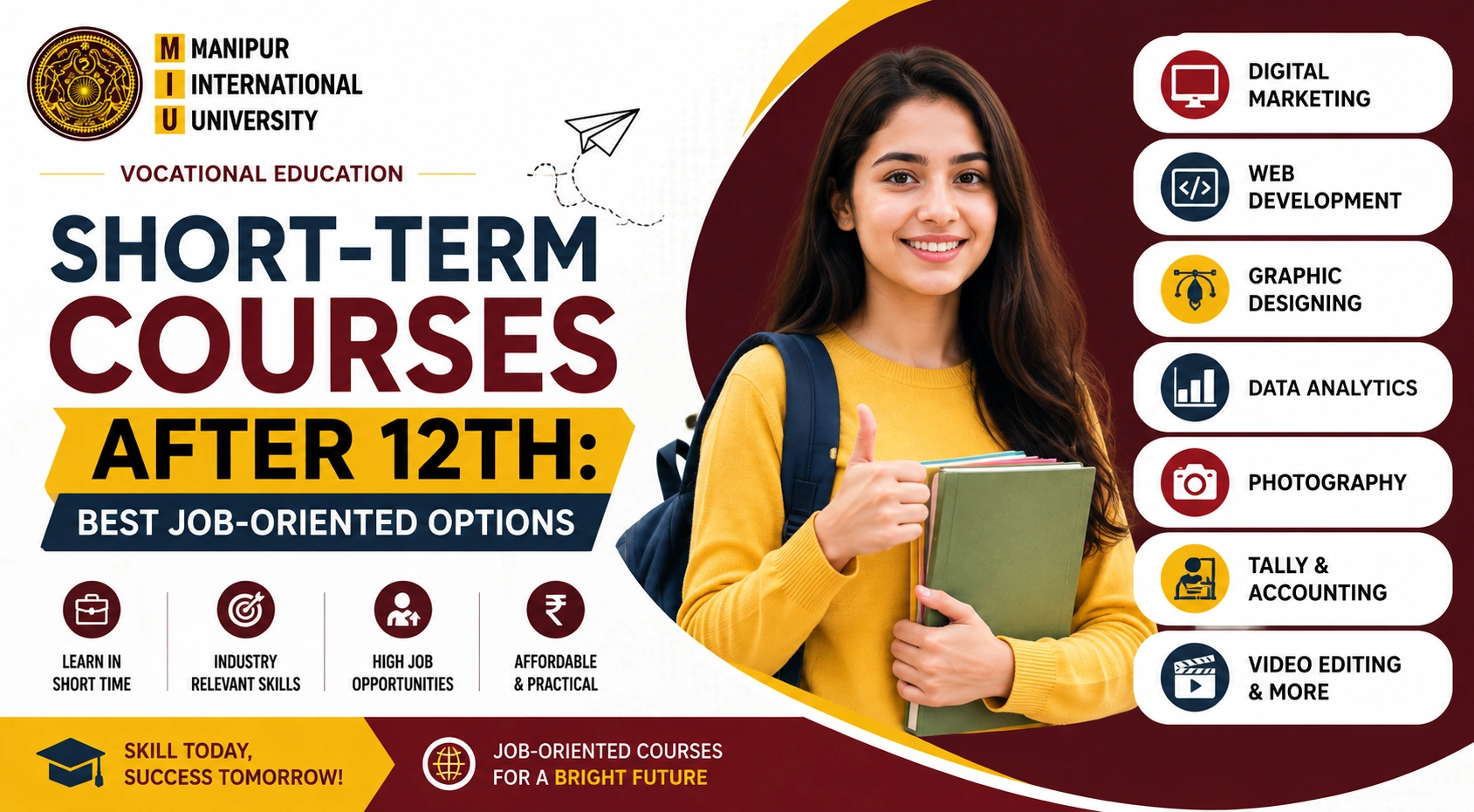
Finished Class 12 and not sure you want to jump straight into a three-year degree? You are not alone. Many students want to learn a real, usable skill quickly and start working or freelancing sooner. That is exactly where short term courses after 12th fit in.
These are short-duration, skill-focused programs that teach you one practical area, like digital marketing, web design, or accounting software. Most run for a few weeks to a year, and many end with a certificate.
This guide explains what these courses are, who they suit, popular options by stream, eligibility, fees, and how to pick the right one. By the end, you will know whether a short course is a smart next step for you.
What Are Short-Term Courses After 12th?
A short-term course is a focused training program that teaches one skill in a short time. Instead of studying many subjects for years, you learn one practical area deeply and quickly.
Here is what usually defines them:
- Duration: Anywhere from a few weeks to about a year. There is no single fixed length. It depends on the course and the institute.
- Focus: Skills you can use at work, not broad theory.
- Outcome: Many give a certificate on completion.
- Learning style: Hands-on practice, projects, and tools.
The main difference from a degree is depth and scope. A degree (like B.Com or B.Sc) runs for three or more years and covers a full subject with academic depth. A short course trains you in one job task or tool. Both are useful, just for different goals.
If you want a broader view of longer skill programs, our guide on vocational courses after 12th covers those in detail.
Why Choose a Short-Term Course After 12th?
Short courses appeal to students who want quick, practical results. They are not a shortcut to success, but they do help you build a skill fast.
Common reasons students pick them:
- Faster skill building: You learn a usable skill in weeks or months, not years.
- Practical learning: Most time goes into doing, not just reading.
- Lower time commitment: Good if you want to earn or explore before a longer course.
- Career exploration: Try a field like design or marketing before committing to a degree in it.
- Skill enhancement: Add a skill on top of your regular studies.
- Entry-level readiness: Build a base for junior roles, internships, or freelance work.
- Flexible pairing: Many students do a short course alongside a degree.
A short course is best seen as a booster, not a full replacement for higher education in every case.
Best Short-Term Courses After 12th
There is no single "best" course. The right one depends on your interest, stream, and career goal. Below are popular skill areas students explore after Class 12.
Durations here are marked "Varies" where they genuinely change from one institute to another. Always confirm the exact length before you enrol.
|
Course/Area |
Typical Duration* |
Skills Learned |
Career Areas |
|
Digital Marketing |
Varies (approx. 3–6 months) |
SEO, social media, ads, content |
Marketing assistant, social media roles, freelancing |
|
Web Development |
Varies by program |
HTML, CSS, JavaScript, basic frameworks |
Junior web developer, freelance projects |
|
Graphic Design |
Varies (few months) |
Design tools, layout, branding basics |
Design assistant, freelance designer |
|
Data/Analytics Skills |
Varies by program |
Excel, data handling, basic visualization |
Data entry, analyst support roles |
|
Healthcare Skill Programs |
Varies (eligibility applies) |
Patient support, lab or care basics |
Support roles in clinics, labs |
|
Beauty & Wellness |
Varies by institute |
Grooming, skincare, salon skills |
Salon roles, self-employment |
|
Hospitality |
Varies by program |
Front office, food service, guest handling |
Hotels, restaurants, events |
|
Accounting/Business Skills |
Varies (few months) |
Tally, GST basics, bookkeeping |
Accounts assistant, small-business support |
|
Multimedia/Animation |
Varies by program |
2D/3D basics, editing, motion graphics |
Studios, freelance, content teams |
|
Spoken English/Communication |
Varies (short) |
Speaking, writing, presentation |
Useful across most jobs |
*Durations vary by institute and program. Confirm official details before enrolling.
3-Month Courses After 12th
A three-month course works well for skills you can start using at a basic level quickly. You will not become an expert in 90 days, but you can build a solid foundation.
Skills that fit a roughly three-month window often include:
- Basics of digital marketing (social media, simple ads, content writing)
- Entry-level graphic design using common design tools
- Spoken English and communication training
- Basic computer applications and office software
- Introductory accounting software skills
Keep expectations realistic. A 3 month course after 12th gives you a starting point. To go job-ready, you will usually need extra practice, projects, or a longer program. Treat short options as step one, not the finish line.
6-Month Courses After 12th
Six months gives you more room to practice and go deeper. You can move past the basics and build a small portfolio.
In a six-month skill program, you can often expect:
- More practice time: Repeated hands-on work builds confidence.
- Project work: Real assignments you can show to employers.
- Certification: Many programs give a completion certificate.
- Career relevance: A stronger base for entry-level roles or internships.
For fields like web development, digital marketing, or design, a longer program usually prepares you better than a very short one. Again, exact durations depend on the institute, so check before you sign up.
Short-Term Certificate Courses After 12th
A certificate course gives you proof that you completed training in a specific skill. It shows an employer you have learned the basics of that area.
Who should consider one: Students who want a quick, focused qualification, or those adding a skill next to a degree.
How certificates differ from diplomas and degrees:
- Certificate: Short, skill-focused, quick to complete.
- Diploma: Longer, more detailed, often more recognized.
- Degree: Multi-year, academic and in-depth.
Before you enrol in any certificate course after 12th, check three things carefully:
- Recognition: Is the certificate valued by employers or a known body?
- Curriculum: Does it cover current, practical skills?
- Practical training: How much hands-on work is included?
A certificate helps most when the training behind it is strong. The paper alone means little without real skills.
Short-Term Courses After 12th Science
Science students often have a wide range of options because many technical and health-linked programs suit their background.
Areas worth exploring:
- IT and programming: Web development, coding basics, software tools.
- Data and analytics: Excel, data handling, and reporting skills.
- Healthcare skill programs: Some support roles in labs or clinics. Note that many of these have specific eligibility rules, and some need a Biology background. Always check.
- Technical skills: Electronics, lab assistance, or equipment handling.
- Design and technology: Multimedia, animation, or CAD basics.
If you took PCB, healthcare-linked short programs may suit you. If you took PCM, technical and IT courses are a natural fit. Confirm eligibility for each course, since stream rules differ.
Short-Term Courses After 12th Commerce
Commerce students already understand business basics, so skill courses in finance and business often feel familiar.
Popular directions include:
- Digital marketing: SEO, social media, and online ads.
- Accounting software: Tally, GST basics, and bookkeeping.
- Business skills: Sales, communication, and office management.
- Data and analytics: Excel and basic data reporting.
- Computer applications: Useful across almost all office jobs.
Most of these are open to students from any stream, so eligibility is rarely a barrier for Commerce students. A short accounting course, for example, pairs well with a B.Com if you plan to study further too.
Short-Term Courses After 12th Arts
Arts students often shine in creative and people-facing fields. Many short courses match these strengths well.
Strong options include:
- Digital marketing: Content, social media, and campaigns.
- Graphic design: Visual design for brands and social platforms.
- Multimedia and animation: Editing, motion graphics, and content creation.
- Beauty and wellness: Salon and grooming skills, often with self-employment scope.
- Hospitality: Hotels, events, and guest services.
- Content and communication: Writing, spoken English, and presentation skills.
These fields usually value your portfolio and communication more than your stream. So Arts students can compete strongly in creative and service careers.
Job-Oriented Short-Term Courses After 12th
A course is "job-oriented" when it trains you for tasks employers actually need, not just theory. The goal is to make you useful from day one in a junior role.
Look for these features in a job-oriented program:
- Practical training: Most time spent doing real work.
- Industry-relevant skills: Tools and methods used in actual jobs.
- Projects: Assignments that build proof of skill.
- Internships: Some programs include them; check if yours does.
- Portfolio building: Especially important for design, marketing, and web roles.
- Certification: A completion certificate to show employers.
- Career support: Some institutes offer guidance. Confirm what is actually provided.
One honest note: no genuine course can promise a guaranteed job. Your results depend on your skills, effort, and the market. Be careful of any institute that promises 100% placement.
Short-Term Courses After 12th Without a Degree
Yes, many skill and certificate programs do not require a bachelor's degree. Class 12 completion is often enough for entry.
Fields like digital marketing, design, and web development care a lot about what you can do. A strong portfolio can matter more than a degree for freelance and junior creative roles.
But be realistic. Some careers still need a degree or professional qualification. For example, many corporate, government, and specialized roles list a degree as a basic requirement. A short course can open a door, but it does not replace higher education everywhere.
The smart approach for many students is to combine both: build a skill now, and continue your degree. That way you keep all your options open.
Eligibility for Short-Term Courses After 12th
Eligibility changes from course to course, so always read the specific requirements. Still, some general rules apply.
Common eligibility points:
- 12th completion: Most courses need you to have passed Class 12 from a recognized board.
- Stream requirements: Some technical or healthcare programs ask for a specific stream (for example, Science with Biology).
- Course-specific rules: Certain courses may need a basic entrance test or interview.
- Age requirements: A few programs set a minimum age. Most short courses do not.
- Institution conditions: Individual institutes may add their own rules.
The safest step is to check the official course page or ask the admissions office directly before you apply.
Fees for Short-Term Courses After 12th
Fees vary widely, so it is impossible to give one number that fits all courses. Instead, understand what pushes the cost up or down.
Factors that affect fees:
- Course duration: Longer programs usually cost more.
- Institution: Reputed institutes may charge higher fees.
- Mode of learning: Online courses are often cheaper than classroom ones.
- Practical training: Hands-on labs and equipment add to cost.
- Certification: Recognized certificates can raise the price.
- Equipment or lab needs: Design, tech, and healthcare courses may cost more.
- Specialization: Niche or advanced skills can be priced higher.
Some free and low-cost options also exist through government skill schemes and online platforms. Always confirm the exact fee in INR from the official source before enrolling, and ask what is included.
Short-Term Course vs Diploma vs Degree
Students often confuse these three. They are all valid paths, just built for different goals. Here is a simple comparison.
|
Factor |
Short-Term Course |
Diploma |
Degree |
|
Duration |
Weeks to about a year |
Usually 1–3 years |
Usually 3–4 years |
|
Learning focus |
One specific skill |
Broader technical training |
Full academic subject |
|
Skill depth |
Basic to intermediate |
Intermediate to strong |
Deep and comprehensive |
|
Certification |
Certificate |
Diploma |
Degree |
|
Career use |
Entry-level, freelance, skill add-on |
Technical and mid-level roles |
Wide range, including higher roles |
|
Higher-study options |
Limited on its own |
Some pathways available |
Widest options (PG, etc.) |
No option is universally "better." A short course suits quick skills, a diploma suits deeper technical training, and a degree suits long-term and academic careers.
How to Choose the Right Short-Term Course After 12th
Picking well matters more than picking fast. Use this 10-point checklist before you decide.
- Identify your career interest. Pick a field you actually enjoy.
- Check eligibility. Confirm your stream and marks qualify you.
- Compare duration. Match the length to your time and goals.
- Review the curriculum. Look for current, practical topics.
- Check practical training. More hands-on work means better learning.
- Verify certification. Find out who issues it and if it is recognized.
- Research the institution. Read reviews and check its track record.
- Check the fees. Confirm the full cost in INR and what is included.
- Look at career opportunities. See what roles the skill can lead to.
- Consider future study plans. Make sure it fits with a degree later if needed.
Take your time with steps 4 to 7. A weak course with a fancy name wastes both money and months.
Career Opportunities After Short-Term Courses
Short courses can open doors to entry-level jobs, internships, and freelance work. They give you a starting skill that you build on with experience.
Possible directions by field:
- Digital marketing: Social media, content, and marketing support roles.
- Design and multimedia: Junior design and content creation work.
- Web development: Junior developer and freelance projects.
- Accounting: Accounts assistant and bookkeeping support.
- Beauty, wellness, hospitality: Service roles and self-employment.
Be honest with yourself about outcomes. Your success depends on many things:
- Course quality and how much you practice
- Your actual skills and experience
- Your portfolio and how you present it
- Your location and local job demand
- What employers in your field require
- Whether you continue further education
A short course is a strong first step. Your effort after it decides how far you go.
Conclusion
Short courses after Class 12 are a smart way to build one practical skill quickly, especially if you are not ready for a long degree yet. They work best when you treat them as a real learning step, not a magic shortcut.
Key takeaways:
- Durations, fees, and eligibility differ by course, so always check official details.
- Match the course to your stream, interest, and career goal.
- Look for practical training, recognized certification, and a solid institute.
- No honest course can guarantee a job; your skills and effort matter most.
Next step: shortlist two or three courses, compare them using the checklist above, and confirm the details before you enrol.